

 Back
Back


 Back to Catagories


Table of Contents


 + 44 7452
122728
+ 44 7452
122728
 07-Sep-2026
Veronica Davis
Leadership is the timeless art of shaping the way teams think and grow. But if you thought it's a one-size-fits-all concept, think again! Some leaders thrive by setting clear goals and rewarding performance, while others inspire innovation and motivate teams through a shared vision. That's where a firm grasp on the difference between Transactional vs Transformational Leadership comes in handy.
Understanding the unique strengths and limitations of each leadership style is important for any aspiring leader and even experienced professionals. In this blog, we will explore Transactional vs Transformational Leadership, to help you identify which style best fits your workplace situations and leadership challenges. So read on!
What is Transactional Leadership?
Transactional Leadership is a management style built on structure and outcomes driven by performance. Leaders who are adept at this approach establish distinct roles, set clear measurable goals and track the progress to make sure that the tasks are completed properly.
Transactional Leaders motivate employees via a system of exciting rewards for meeting objectives as well as some corrective actions in case the performance falls below expectations. This approach keeps teams focused on organisational goals while maintaining stability and delivering predictable outcomes.
1) Characteristics of Transactional Leadership
Here are the main characteristics of Transactional Leadership:
a) Focus on Short-term Results: This leadership style prioritises the immediate objectives. This is accomplished by setting clear performance expectations, tracking progress on a regular basis and measuring the outcomes relative to predefined targets.
b) Structured Roles and Hierarchies: In this style of leadership, team members function within clearly defined reporting structures. These structures lay down the specific responsibilities and expectations.
c) Reward-driven Motivation: Employees are motivated through exciting incentives such as bonuses, recognition, promotions or other performance-based rewards.
2) When to Use Transactional Leadership
Transactional Leadership is particularly effective in the following situations:
a) When Rapid Achievement is Needed: Teams that work under tight deadlines, demanding deliverables or highly ambitious performance targets benefit greatly from this style of leadership.
b) When Work is Repetitive: Environments like manufacturing, logistics, operations and customer service often require consistent execution of set procedures. This makes Transactional Leadership well suited to driving efficiency.
c) When Compliance is Critical: Industries such as finance, healthcare and legal services require strict adherence to policies and quality standards. A transactional approach helps ensure compliance.

What is Transformational Leadership?
Transformational Leadership is strictly centred around people as it spotlights the importance of long-term growth. It focuses on motivating employees towards a shared vision while prompting innovation and personal growth. Transformational Leaders empower their teams and create a workplace where individuals can feel confident about exceeding expectations. This leadership style places strong emphasis on collaboration and creativity.
1) Characteristics of Transformational Leadership
Here are the main characteristics of Transformational Leadership:
Vision-led and Collaborative: Transformational Leaders are experts at uniting teams with a shared vision. They involve employees in shaping the organisation's future direction.
Focus on Individual Development: These leaders support employee growth through coaching and mentoring. This helps the employees develop new skills and prepare for future leadership roles.
People-centred and Culture-centred Approach: These leaders build a culture of empowerment and autonomy. This encourages individuals to act responsibly even when direct supervision is limited.
2) When to Use Transformational Leadership?
Transformational Leadership works well in the following situations:
When Driving Cultural or Organisational Change: When implementing new ways of working or transforming existing processes, this leadership style builds enthusiasm and encourages employees to embrace change.
When Operating in Innovative Industries: Sectors like technology, consulting, research and design can benefit from leaders who encourage creativity and independent problem-solving.
When Seeking Long-term Employee Engagement: Organisations focused on retention and sustained Performance Management often find that purpose-driven motivation creates deeper commitment than incentives alone.
Transactional vs Transformational Leadership: Key Differences
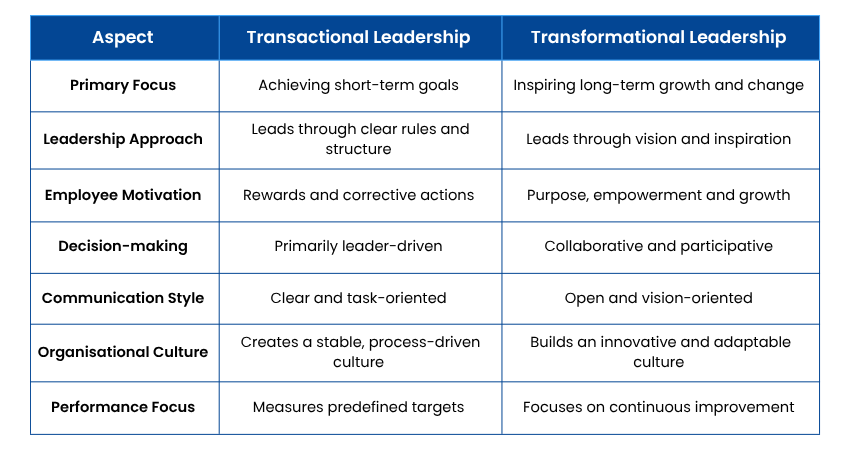
Transactional and Transformational Leadership represent two distinct approaches to leading people. Picking the right leadership style can have a great impact on employee performance, organisational culture and business outcomes. Let's explore the differences between Transactional and Transformational Leadership in detail:
1) Primary Focus
The primary focus of Transactional Leadership is achieving short-term goals via clear expectations and structured processes. In contrast, Transformational Leadership focuses on inspiring long-term growth by encouraging employees to get excited about change and innovate.
2) Leadership Approach
Transactional Leaders go for a structured approach by relying on established rules, defined responsibilities and close supervision to achieve objectives. Transformational Leaders take a more inspirational approach as they motivate employees through trust and empowerment while encouraging independent thinking.
3) Employee Motivation
Transactional Leadership motivates employees through external rewards such as bonuses, recognition and performance-based incentives, alongside corrective actions when expectations are not met. Transformational Leadership, however, inspires employees by creating a sense of purpose, empowering them to grow and encouraging them to achieve beyond expectations.
4) Decision-making
In Transactional Leadership, decision-making is primarily leader-driven, with managers providing clear instructions and maintaining control over key decisions. Transformational Leadership encourages a collaborative approach by involving employees in discussions, valuing their ideas and promoting shared decision-making wherever possible.
5) Communication Style
Transactional Leaders communicate clearly and directly, focusing on tasks, expectations and performance standards. Transformational Leaders use open, engaging communication to share their vision, encourage feedback and strengthen relationships with their teams.
6) Organisational Culture
Transactional Leadership creates a stable, process-driven culture where consistency, discipline and compliance are prioritised. On the other hand, Transformational Leadership creates an innovative and adaptable culture that encourages creativity, continuous learning and openness to change.
7) Performance Focus
Transactional Leadership measures success against predefined targets. This assures that the employees meet the established objectives and performance standards. In comparison, rather than short-term outcomes alone, Transformational Leadership focuses on continuous improvement by encouraging innovation and skill development.
Inspire teams and drive success with CMI Level 5 Award in Management and Leadership Training - Sign up now!
Applications of Transactional and Transformational Leadership
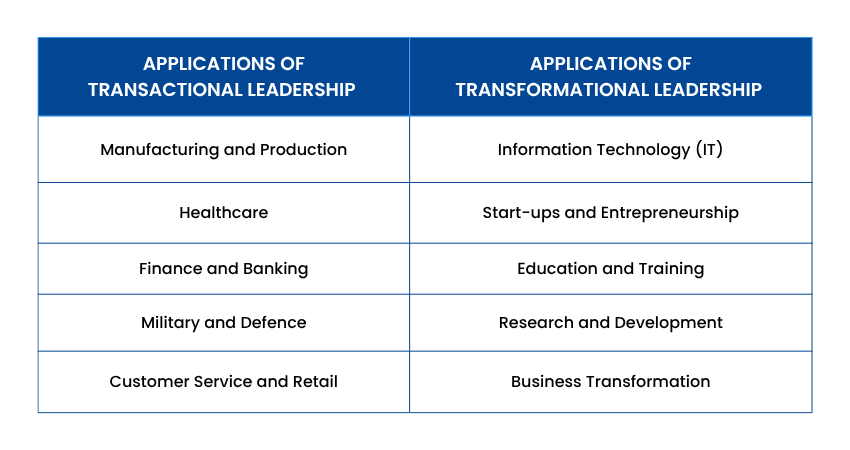
The application of Transactional and Transformational Leadership depends on an organisation's goals, culture and the type of work being performed. Let's explore their applications:
1) Applications of Transactional Leadership
Transactional Leadership is widely applied in environments where consistency, efficiency and compliance are essential. Common applications include:
Manufacturing and Production: In this field, Transactional Leadership makes sure that standard operating procedures are followed and quality standards are maintained.
Healthcare: In this sector, this leadership style supports compliance with clinical protocols, safety regulations and patient care standards.
Finance and Banking: Here, Transactional Leadership helps maintain regulatory compliance, accuracy and risk management.
Military and Defence: It provides clear command structures, discipline and efficient execution of tasks as needed in this field.
Customer Service and Retail: In this sector, Transactional Leadership improves operational consistency, service quality and Performance Management.
2) Applications of Transformational Leadership
Transformational Leadership is commonly applied in organisations that prioritise innovation, collaboration and long-term growth. Typical applications include:
Information Technology (IT): In this sector, Transformational Leadership encourages innovation, digital transformation and creative problem-solving.
Start-ups and Entrepreneurship: In this sector, this style of leadership inspires teams to adapt quickly, take initiative and pursue ambitious goals.
Education and Training: Transformational Leadership promotes continuous learning, leadership development and collaboration.
Research and Development: In this vital sector, Transformational Leadership builds creativity in the development of new products or solutions.
Business Transformation: Transformational Leadership helps organisations manage and improve employee engagement and implement new strategies successfully.
Transform your leadership potential into measurable career growth with the CMI Level 5 Certificate in Management and Leadership Training – Register today!
Challenges and Limitations of Transactional vs Transformational Leadership
Although Transactional and Transformational Leadership can drive organisational success, each comes with its own set of challenges and limitations. Understanding these drawbacks helps leaders apply the right approach based on their team's needs, organisational goals and workplace environment.
Challenges and Limitations of Transactional Leadership:
1) It focuses more on managing tasks and processes than inspiring employees.
2) Strict rules and procedures can limit creativity, innovation and flexibility.
3) A heavy emphasis on individual performance may create unhealthy competition among employees.
4) It can reduce collaboration and trust, thus making it harder to achieve long-term organisational goals.
5) Employees may become dependent on rewards and struggle to stay motivated without incentives.
Challenges and Limitations of Transformational Leadership:
1) There is a chance employees may resist major organisational changes or feel uncertain about new directions.
2) Continuous focus on innovation and high expectations can increase the risk of employee burnout.
3) Strong emphasis on a shared vision may sometimes reduce individual viewpoints and independent thinking.
4) It requires leaders with strong motivational skills; otherwise it is ineffective.
5) Some employees prefer structured guidance rather than greater autonomy.
Transactional vs Transformational Leadership: Which Leadership Style is Better?
No leadership style can be looked upon as better than the other. That is because the ideal choice is based on the organisational goals, the needs of the team and the specific situation they are facing. Instead of depending on one style, leaders can achieve better results by combining the best of both leadership styles.
For example, a logistics company might use Transactional Leadership to make sure the employees meet delivery schedules and maintain quality standards. At the same time, they can apply Transformational Leadership to encourage innovation and adopt new technologies. This approach paves the way for better ways to improve customer service. Successful leaders understand the strengths of both approaches and know when to use each one to achieve the best outcomes.
Conclusion
For any modern aspiring leader, understanding the Transactional vs Transformational Leadership distinctions is key. That's because each style brings unique strengths to the workplace. While Transactional Leaders excel at maintaining structure and accountability, Transformational Leaders inspire innovation and long-term change. By understanding these unique approaches, professionals can develop a more adaptable leadership mindset.
Take the next leap toward leadership excellence with the CMI Level 5 Courses - Sign up now!
Frequently Ask Questions
What is an Example of a Transactional Leader?
A retail Store Manager can be an example of a Transactional Leader. They assign clear responsibilities, monitor employee performance and reward employees for meeting sales targets while addressing poor performance through corrective actions to maintain operational efficiency and customer service standards.
What are the Five C's of Transformational Leadership?
The five C's of Transformational Leadership help leaders inspire teams, embed innovation into the process, communicate a clear vision and lead organisations through change. The five C’s are:
a) Clarity
b) Competence
c) Communication
d) Collaboration
e) Commitment
What Skills are Important for Transformational Leaders?
Transformational Leaders need the following skills:
a) Strong communication
b) Emotional intelligence
c) Strategic thinking
d) Problem-solving
e) Adaptability
f) Team-building
g) Encouraging innovation
Related Blogs
Didn’t Find What You’re Looking For?

Our commitment to excellence ensures an exceptional learning experience tailored to your professional development needs.


© Copyright 2026 - Oakwood International ™ - All rights reserved.


SUPER SALE
 Get Amazing Discounts
And Deals
Get Amazing Discounts
And Deals