

 Back
Back


 Back to Catagories


Table of Contents


 + 44 7452
122728
+ 44 7452
122728
 16-Jun-2026
Hailey Davis
Employee Performance is more than completing tasks and meeting deadlines. It reflects how effectively employees contribute to business goals, collaborate with colleagues, solve problems, and create value for the organisation. High-performing employees help businesses innovate, improve customer satisfaction, and stay competitive in a rapidly changing market.
By measuring performance effectively and providing the right support, organisations can help employees grow while improving overall business outcomes. In this blog, we will explore what is Employee Performance, why it is important, the factors that influence it, and practical strategies for improving performance in the workplace. Let's get started!
What is Employee Performance?
Employee Performance reflects how well an employee fulfils their job responsibilities and contributes to achieving business objectives. It is measured by the quality, quantity, and efficiency of their work. Performance also encompasses behaviours such as teamwork, communication, reliability, and problem-solving. Together, these factors show the value an employee brings to the workplace.
Understanding Employee Performance helps organisations evaluate how well their workforce supports business objectives. It highlights strengths, identifies areas for improvement, and supports informed decision-making. Strong Employee Performance can improve productivity, employee engagement, and customer satisfaction. It also helps businesses achieve sustainable growth and long-term success.

Why is Employee Performance Important?
Employee Performance is important for many reasons because it directly influences an organisation’s ability to achieve its goals and maintain long-term success. The following reasons highlight why Employee Performance is an important aspect of every business:
1) Supports Business Growth: Strong Employee Performance contributes to improved operational results and overall business success. It enables organisations to meet targets, adapt to change, and maintain a competitive advantage.
2) Increases Productivity and Efficiency: High-performing employees complete tasks accurately and on time. This helps organisations improve productivity, reduce delays, and achieve business objectives effectively.
3) Improves Employee Engagement: Employees who understand expectations and receive recognition for their contributions are more engaged in their work. Greater engagement often leads to higher motivation and commitment.
4) Enhances Customer Satisfaction: Employees who perform well are more likely to deliver high-quality products, services, and customer experiences. This helps build trust, loyalty, and long-term customer relationships.
5) Strengthens Employee Retention: A workplace that encourages performance development creates opportunities for growth and career progression. This can improve job satisfaction and reduce employee turnover.
6) Creates a Positive Workplace Culture: Consistent performance standards encourage accountability, collaboration, and continuous improvement. This helps foster a supportive and high-performing work environment.
7) Enables Better Decision-making: Performance data provides valuable insights into employee strengths, skill gaps, and areas for improvement. Managers can use this information to make informed decisions about employee training, development, and resource allocation.
What are the Elements of a Successful Employee Performance Strategy?
A successful Employee Performance strategy combines clear expectations, continuous support, development opportunities, and regular evaluation to help employees perform at their best. Key elements include:
1) Clear Goals and Expectations: Define measurable objectives that align employee efforts with business priorities.
2) Regular Feedback and Communication: Provide ongoing guidance, constructive feedback, and open communication.
3) Learning and Development Opportunities: Support skill development through training, coaching, and structured career development initiatives.
4) Recognition and Rewards: Acknowledge achievements to boost motivation, engagement, and job satisfaction.
5) Performance Measurement and Analysis: Use performance data and metrics to track progress, identify trends, and drive continuous improvement.
When these elements work together, organisations can improve productivity, strengthen employee engagement, and achieve better business outcomes.
Build stronger leadership skills with CIPD Level 5 Associate Diploma in People Management – Join now!
How is Employee Performance Measured?
The way Employee Performance is measured can vary across organisations. Several widely used methods and metrics can help organisations evaluate performance and gain a clearer understanding of employee effectiveness, including:
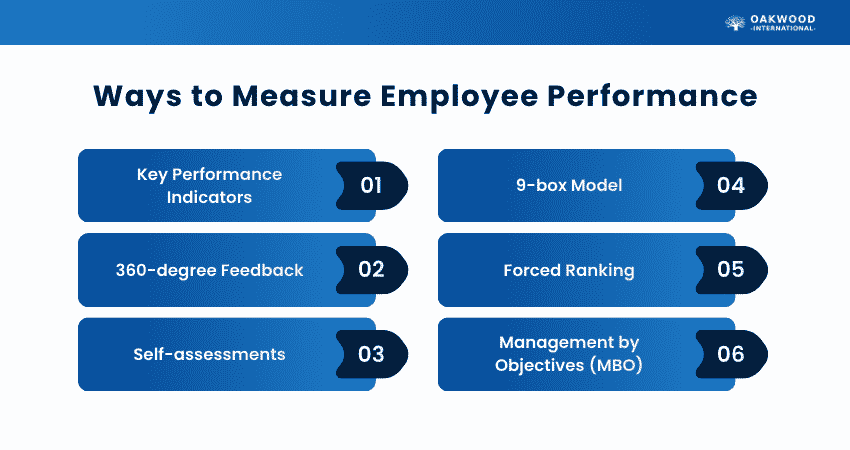
1) Key Performance Indicators
Key Performance Indicators (KPIs) are measurable metrics used to evaluate Employee Performance against specific goals. They provide clear benchmarks for assessing productivity, quality, efficiency, and overall contribution to business objectives. Well-defined KPIs help employees understand expectations and priorities.
KPIs also support objective performance reviews by relying on measurable results rather than opinions. Managers can use KPI data to track progress, identify strengths, and address performance gaps. Regular monitoring encourages accountability and continuous improvement.
2) 360-degree Feedback
360-degree feedback gathers performance insights from multiple sources, including managers, peers, direct reports, and sometimes customers. This approach provides a broader view of an employee's strengths, behaviours, and workplace interactions.
The feedback highlights areas that may not be visible through traditional reviews alone. It encourages self-awareness, improves communication, and supports professional development. Organisations often use it to strengthen leadership and teamwork skills.
3) Self-assessments
Self-assessments allow employees to evaluate their own performance, achievements, and challenges. They encourage individuals to reflect on their progress and take ownership of their development.
This method promotes open discussions between employees and managers during performance reviews. It can reveal valuable insights into employee goals, motivations, and perceived areas for improvement. Self-assessments also support a culture of continuous learning.
4) 9-box Model
The 9-box model is a talent management tool that evaluates employees based on two factors such as performance and future potential. Employees are placed within a nine-cell grid that helps organisations identify high performers and emerging talent.
This framework supports succession planning and development decisions. It helps leaders determine where to invest training and growth opportunities. The model also provides a structured approach to workforce planning.
5) Forced Ranking
Forced ranking is a performance evaluation method that compares employees against one another. Individuals are ranked based on their overall performance within a team or department.
This approach helps organisations identify top performers and employees who may require additional support. However, it should be applied carefully to avoid unhealthy competition. When balanced effectively, it can assist with talent management and performance differentiation.
6) Management by Objectives (MBO)
Management by Objectives (MBO) focuses on setting clear goals that employees and managers agree upon. These objectives are aligned with broader organisational priorities and provide a shared direction for performance.
Progress is measured against the achievement of these predefined goals. Regular reviews help ensure employees remain focused and supported throughout the process. MBO promotes accountability, transparency, and goal-oriented performance management.
Align people strategies with business objectives with the CIPD Level 7 Advanced Diploma in Strategic People Management Course - Register today!
Key Employee Performance Metrics to Track
Tracking Employee Performance metrics is mandatory for understanding how effectively individuals and teams contribute to organisational goals. Here are some key metrics that organisations can use to evaluate Employee Performance and identify opportunities for improvement:
1) Employee Work Efficiency
Employee work efficiency measures how effectively individuals complete tasks using available time and resources. Higher efficiency often indicates strong productivity and effective work processes.
2) Quality of Work
The quality of work evaluates the accuracy, consistency, and standard of completed tasks. High-quality work reduces errors and contributes to better business outcomes.
3) Employee Engagement
Employee engagement reflects an employee's commitment, motivation, and involvement in their work. Engaged employees are often more productive and likely to contribute positively to organisational goals.
4) Time Management
Time management measures how employees organise and complete their responsibilities within set deadlines. Strong time management helps employees focus on important tasks, minimise delays, and maintain consistent productivity throughout the workday.
5) Errors Made
Tracking errors helps organisations assess accuracy and identify areas for improvement. A lower error rate often indicates greater attention to detail and process effectiveness.
6) Number of Sales
The number of sales measures how many successful sales an employee completes within a specific period. It is a key metric for evaluating sales performance and revenue contribution.
7) Number of Units Produced
This metric tracks the quantity of products or outputs generated by an employee or team. It is particularly useful for measuring productivity in manufacturing and production environments.
8) Revenue Per Employee
Revenue per employee calculates the amount of revenue generated by each employee. It provides insight into workforce productivity and overall organisational efficiency.
9) Absenteeism
Absenteeism measures how often employees are absent from work during a given period. Monitoring absenteeism can help identify potential engagement, well-being, or workplace issues.
10) Overtime
Overtime tracks the additional hours employees work beyond their normal schedules. It helps organisations understand workload demands and resource allocation.
11) Learning and Development Participation
This metric measures employee involvement in training and professional development activities. Regular participation demonstrates a commitment to skill development and continuous improvement.
12) Conversion Rate
Conversion rate measures how successfully employees turn leads, prospects, or opportunities into completed outcomes. It is widely used in sales and customer-facing roles.
13) Task Prioritisation and Completion Rate
This metric evaluates how effectively employees prioritise responsibilities and complete assigned tasks. High completion rates often indicate strong organisation and productivity.
14) Cost Per Task
Cost per task measures the resources required to complete a specific activity or piece of work. It helps organisations evaluate operational efficiency and cost effectiveness.
15) Goal Achievement Rate
Goal achievement rate measures how successfully employees meet the objectives and targets assigned to them within a specific period. It helps organisations evaluate individual performance by comparing completed goals against planned outcomes.
16) Response Time
Response time measures how quickly employees respond to customer requests, enquiries, or internal communications. Faster response times often improve service quality and customer satisfaction.
17) Cost Per Acquisition
Cost per acquisition measures the cost involved in acquiring a new customer or client. It helps organisations evaluate the efficiency of their sales and marketing efforts.
18) Active Leads
Active leads track the number of potential customers currently progressing through the sales pipeline. This metric provides insight into future sales opportunities and business growth.
19) Human Capital ROI (Return on Investment)
Human capital ROI measures the value generated from investments in employees, including salaries, benefits, and development initiatives. It helps organisations assess workforce effectiveness and business impact.
20) Customer Satisfaction Score (CSAT)
Customer Satisfaction Score (CSAT) measures how satisfied customers are with a product, service, or interaction. High CSAT scores often indicate strong Employee Performance and excellent customer experiences.
Develop a solid foundation in HR and people practices with the CIPD Level 3 Certificate in People Practice Course – Join now!
How to Improve Employee Performance?
Regardless of the evaluation method used, reviewing the results can help identify performance gaps and development opportunities. The following strategies can help organisations enhance Employee Performance and support continuous improvement:
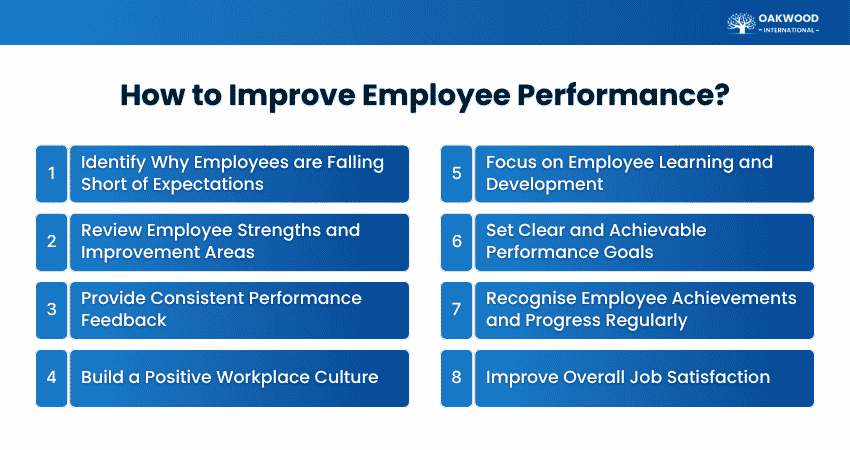
1) Identify Why Employees are Falling Short of Expectations
The first step in improving Employee Performance is understanding the root cause of the issue. Performance challenges may arise from unclear expectations, lack of resources, insufficient training, or personal factors affecting work.
By identifying the underlying reasons, managers can provide targeted support and develop effective solutions. Addressing problems early helps prevent performance issues from escalating.
2) Review Employee Strengths and Improvement Areas
Regularly assessing employee strengths and areas for improvement provides a balanced view of performance. Understanding individual capabilities helps managers recognise achievements while identifying development opportunities.
This approach enables organisations to align employee strengths with business needs and create personalised improvement plans. It also encourages employees to build on their existing skills.
3) Provide Consistent Performance Feedback
Frequent and constructive feedback helps employees understand how their performance aligns with expectations. Ongoing conversations provide clarity, reinforce positive behaviours, and address issues before they become significant concerns.
Regular feedback also promotes trust and open communication between managers and employees. This creates a culture of continuous improvement and accountability.
4) Build a Positive Workplace Culture
A positive workplace culture encourages collaboration, respect, and employee engagement. Employees are more likely to perform well when they feel valued, supported, and connected to organisational goals.
Creating a supportive environment can improve morale, increase motivation, and strengthen team performance. A strong culture also contributes to higher employee retention.
5) Focus on Employee Learning and Development
Providing learning and development opportunities helps employees strengthen existing skills and acquire new capabilities. Training, mentoring, and coaching programmes support both individual and organisational growth.
Investing in employee development demonstrates a commitment to long-term success. It also helps employees adapt to changing job requirements and industry demands.
6) Set Clear and Achievable Performance Goals
Clear and realistic goals give employees a defined direction and purpose. Well-structured goals help individuals understand priorities and focus their efforts on meaningful outcomes.
Regularly reviewing progress against these goals keeps employees motivated and accountable. Achievable targets also build confidence and encourage sustained performance improvement.
7) Recognise Employee Achievements and Progress Regularly
Recognising employee contributions helps reinforce positive behaviours and encourages continued high performance. Acknowledgement can take many forms, from verbal praise to formal reward programmes.
Regular recognition boosts morale and helps employees feel valued for their efforts. It also strengthens engagement and commitment across the organisation.
8) Improve Overall Job Satisfaction
Employees who are satisfied with their roles are often more motivated and productive. Job satisfaction can be influenced by factors such as work-life balance, career opportunities, management support, and workplace relationships.
Organisations that prioritise employee well-being and satisfaction often experience stronger performance and lower turnover. Creating a positive employee experience benefits both individuals and the business as a whole.
Conclusion
Employee Performance plays a vital role in helping employees contribute to organisational goals and support business success. Understanding and improving performance helps organisations increase productivity, strengthen employee engagement, enhance customer satisfaction, and create a positive workplace culture. By focusing on performance management, businesses can drive continuous improvement and achieve long-term growth.
Develop future-ready people and leadership skills with the CIPD Qualification Training – Register now!
Frequently Ask Questions
What are Five Qualities of a Good Employee?
The five qualities of a good employee include:
a) Reliability
b) Strong Communication
c) Adaptability
d) Teamwork
e) A Positive Attitude
These qualities help employees perform effectively, collaborate with colleagues, handle challenges, and contribute to organisational goals while supporting a productive and professional workplace environment.
Which Areas Should Employees Focus on to Improve Performance?
Employees should focus on improving communication, time management, productivity, problem-solving, adaptability, and teamwork. Developing technical skills, setting clear goals, seeking regular feedback, and continuously learning can also enhance performance, increase efficiency, and support long-term career growth.
Why are Employee Performance Reviews Important?
Employee Performance reviews help organisations assess progress, recognise achievements, and identify areas for improvement. They provide valuable feedback, support employee development, align individual goals with business objectives, and encourage continuous growth, engagement, and accountability in the workplace.
Related Blogs
Didn’t Find What You’re Looking For?

Our commitment to excellence ensures an exceptional learning experience tailored to your professional development needs.


© Copyright 2026 - Oakwood International ™ - All rights reserved.


SUPER SALE
 Get Amazing Discounts
And Deals
Get Amazing Discounts
And Deals