

 Back
Back


 Back to Catagories


Table of Contents


 + 44 7452
122728
+ 44 7452
122728
 07-Sep-2026
Maria Thompson
Attracting the right people has become just as important as retaining them. Organisations that get hiring wrong often struggle with performance, stability, and long-term growth. This is why understanding the difference between Talent Acquisition vs Recruitment matters more than ever. Each approach plays a distinct role in shaping how a workforce is built.
As organisations evolve and enter new markets, HR leaders must rethink how they plan their hiring efforts. The conversation around Talent Acquisition vs Recruitment is no longer operational but strategic. It influences workforce planning and business resilience. In this blog, you will explore their differences, benefits, and how each supports smarter hiring decisions.
What is Talent Acquisition?
Talent Acquisition is a long-term strategic approach within Human Resources. It focuses on finding, attracting, hiring, and retaining skilled talent for current and future business objectives. It’s more than filling a vacancy as Talent Acquisition considers the broader goals and vision of the company. Talent Acquisition emphasises employer branding, market analysis, networking, and candidate relationships.
The main long-term objective is to build a sustainable talent pipeline. This approach identifies and engages potential candidates even before vacancies exist. It places the organisation in a favourable position in the market and attracts highly experienced professionals who align with company values and long-term goals.

HR's Role in Talent Acquisition
When it comes to Talent Acquisition, HR is more than just an administrative gatekeeper. The modern HR professional acts as a strategic partner to collaborate with leadership, marketing teams, and hiring managers. HR develops employer branding strategies to enhance organisational culture. It utilises advanced analytics and builds robust talent pools.
Here are some of the main roles:
a) Develops talent attraction strategies
b) Manages employer branding and market positioning
c) Handles networking and relationship management
d) Boosts workforce planning and succession management
e) Utilises technology and analytics to forecast future talent needs.
What is Recruitment?
Recruitment is the process of finding and hiring the right person to fill a specific job vacancy. It focuses on meeting immediate hiring needs by identifying suitable candidates and selecting the best fit for the role. The goal is to fill positions efficiently while ensuring the candidate meets the job requirements.
Recruitment typically involves activities such as advertising job openings, sourcing candidates, reviewing applications, conducting interviews, verifying qualifications, making job offers, and supporting onboarding. It is a practical, short-term approach designed to ensure business operations continue smoothly when vacancies arise.
HR's Role in Recruitment
Human Resources operates as a facilitator of the hiring process in Recruitment. Some of their main responsibilities are:
a) Creating accurate job descriptions and postings
b) Sourcing and screening candidates
c) Coordinating and conducting interviews
d) Managing Applicant Tracking Systems (ATS)
e) Extending job offers and negotiating salary packages
f) Facilitating quick and effective onboarding processes. When it comes to Recruitment, HR focuses heavily on time-to-fill, cost-per-hire, quality-of-hire, and employee turnover.
Ready to lead with confidence? Explore our
Successful People Management and Team Leadership
today!
Talent Acquisition and Recruitment: Key Differences Explained
Here are the major differences between Talent Acquisition vs Recruitment with details for better understanding:

1) Branding
Talent Acquisition: It tries to invest in employer branding as part of a strategic approach. It ensures the company’s image by attracting high-quality candidates for future growth.
Recruitment:
The process relies more on established branding; generally, makes minimal efforts towards new or expanded employer branding initiatives.
2) Investment
Talent Acquisition: This hiring process needs continuous and strategic investment in building candidate relationships. It promotes employer branding initiatives and talent analytics tools to deliver long-term Return On Investment (ROI).
Recruitment:
This is often viewed as cost-driven and tactical, with limited investment. It aims to quickly and efficiently fill open roles without extensive spending.
3) Company Growth
Talent Acquisition: It aligns with organisational growth strategy and contributes significantly to long-term growth and business success. This is done by ensuring the consistent availability of skilled talent.
Recruitment: It focuses proactively on operational requirements and short-term hiring targets. It does not plan any long-term company growth or strategic plans.
Step up your management game: browse our
Workforce Resource Planning Training
now!
4) Focus
Talent Acquisition: It prioritises quality, cultural alignment, and future capabilities. The right candidates often align perfectly with the company’s long-term objectives.
Recruitment:
This process emphasises immediate availability, essential qualifications, and short-term capability. It focuses on performing defined tasks or roles quickly.
5) Timeline
Talent Acquisition: It works with a long-term and strategic perspective. Its timelines are flexible and aim to sustain success and carefully curate talented candidates.
Recruitment:
This has shorter timelines as it aims to emphasise efficiency and filling roles immediately. It hires candidates as swiftly as possible to reduce business disruption.
6) Engagement
Talent Acquisition: It highlights consistent and meaningful candidate engagement over long periods. Candidates are nurtured through the hiring process, often over months or years.
Recruitment:
Here, the engagement primarily starts during the immediate hiring process with limited follow-up once the vacancy is filled.
7) Planning
Talent Acquisition: Here, planning is driven by strategic planning, succession planning, future skills forecasting, and long-term workforce planning. It aims to fulfil future business objectives.
Recruitment:
It is based on temporary planning that mostly involves short-term activities aimed at quickly addressing unexpected vacancies or immediate needs.
8) Candidate Sourcing
Talent Acquisition: It invests mainly in diverse sourcing approaches such as passive candidate sourcing, professional networking, referrals, and social media branding. The main aim is nurturing long-term relationships.
Recruitment:
It mostly uses traditional sourcing methods like job postings, direct applications, Recruitment agencies, and job boards.
9) Approach
Talent Acquisition: Its approach is strategic and relationship-oriented. The objective is to emphasise engagement, culture fit, and future growth for potential candidates.
Recruitment:
It offers a tactical and transactional approach. It focuses on filling vacancies swiftly and efficiently through clearly defined processes and minimal relationship-building.
10) Criteria
Talent Acquisition: Its main criteria include values alignment, long-term potential, leadership capability, and strategic adaptability. The overall alignment is with the organisational vision.
Recruitment: These criteria mainly emphasise technical skills, proven experience, certifications, and immediate performance ability for a specific role.
Unlock your Leadership potential and upgrade your leadership skills — join a
Performance Appraisal Training
now!
What are the Benefits of Talent Acquisition?
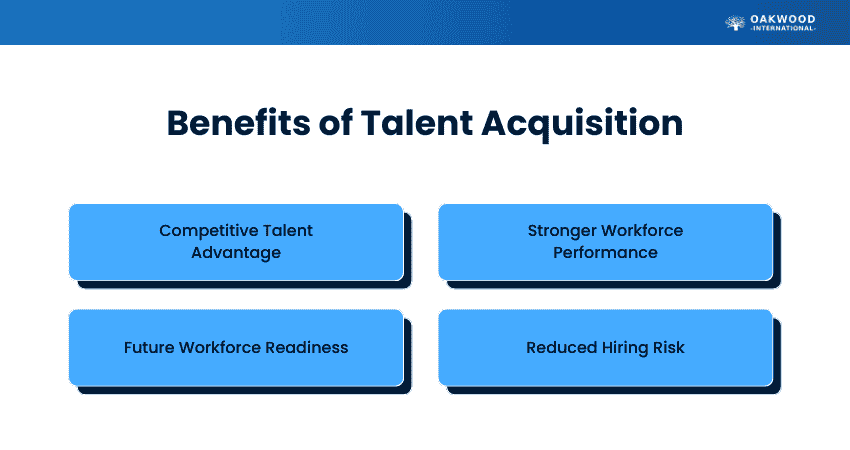
Let’s look at the key benefits of Talent Acquisition to better understand Talent Acquisition vs Recruitment:
1) It Helps Companies Stay Competitive
Talent Acquisition keeps organisations competitive by continuously seeking skilled and innovative professionals. Since high-calibre professionals have multiple offers, companies must position themselves as the preferred choice.
2) It Makes a Company More Successful
A strong Talent Acquisition strategy builds a workforce that is skilled, efficient, and aligned with long-term business goals. When the right candidates are chosen, they require less supervision, make fewer errors, and contribute effectively to the organisation.
3) It Prepares the Company for the Future
Talent Acquisition focuses on long-term workforce planning instead of filling vacancies. Maintaining talent pipelines and staying connected with promising candidates helps companies to prepare for the need for specialised roles or unexpected needs.
4) It Mitigates Business Risk
Talent Acquisition emphasises diligent assessments and strategic alignment, leading to reduction in the number of poor hiring decisions. Bringing competent and suitable candidates helps lower turnover rates and avoid repetitive hiring cycles.
What are the Benefits of Recruitment?
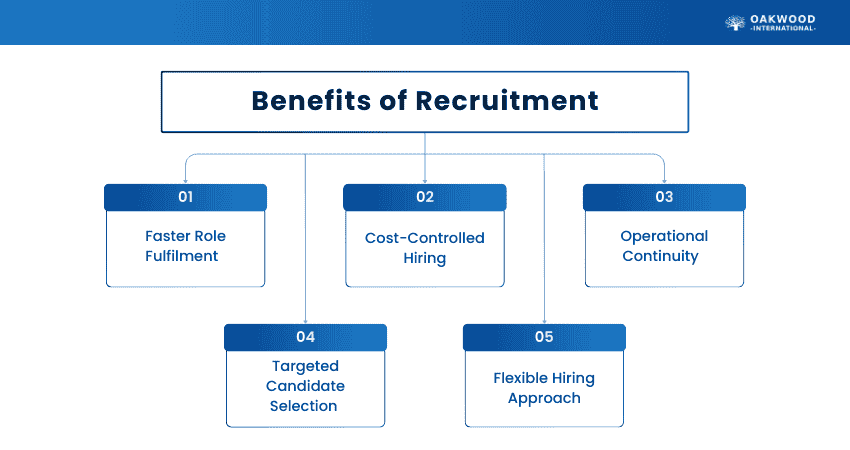
Let’s look at the key benefits of Recruitment:
1) Faster Role Fulfilment
Recruitment helps fill open roles quickly. This keeps work moving without delays. Teams stay productive when vacancies are filled on time. It also reduces pressure on existing employee.
2) Cost-Controlled Hiring
Recruitment helps control hiring costs. Companies focus only on roles that are needed now. This avoids spending more than required. It supports better use of hiring budgets.
3) Operational Continuity
Recruitment supports smooth daily operations. Work does not slow down when positions are filled quickly. This helps teams meet their goals. It keeps service levels consistent.
4) Targeted Candidate Selection
Recruitment focuses on finding the right person for each role. Candidates are chosen based on skills and experience. This improves job performance. It also supports stronger team outcomes.
5) Flexible Hiring Approach
Recruitment supports short-term and urgent hiring needs. Companies can hire based on changing workload. This makes workforce planning easier. It allows businesses to adapt quickly.
Build a high-performing workforce with
Talent Management Training
– Join today!
How to Choose the Right Approach for Your Business?
To determine the right approach between Talent Acquisition vs Recruitment, consider the following factors below.
1) Hiring Needs
Talent Acquisition: Ideal for companies with frequent openings and ongoing growth. It focuses on long-term strategies to attract and retain top talent.
Recruitment:
Suitable for immediate or short-term hiring needs. This is where experienced Recruiters or agencies can quickly fill positions.
2) Role Complexity
Talent Acquisition: Beneficial for roles that need specialised skills, niche experiences, or advanced qualifications.
Recruitment:
Effective for general or straightforward roles. It relies on a Recruiter’s broad candidate network.
3) HR Team Capabilities
Talent Acquisition: Ideal if the HR team manages daily tasks well but lacks strategic foresight. This helps to build long-term planning, Employer Branding , and a strong talent pipeline.
Recruitment:
Best when the HR team is strategically sound but struggles with immediate volume hiring and needs quick placements.
4) Industry Knowledge
Talent Acquisition: Helpful when your HR team lacks industry-specific knowledge or finds it challenging to attract specialised talent.
Recruitment:
It is less critical if your team already understands the industry, job roles, and talent landscape.
5) Time and Resources
Talent Acquisition: When organisations require more resources, time, and long-term planning to implement effectively.
Recruitment:
When organisations need to deliver faster results and demand fewer resources, it is ideal for urgent hiring.
6) Company Culture
Talent Acquisition: Best when building an employer brand, improving culture, and attracting high-quality long-term talent as a priority.
Recruitment:
Appropriate when the primary focus is to quickly fill the immediate vacancies.
Conclusion
Understanding Talent Acquisition vs Recruitment is essential for building a strong and future-proof workforce. The most effective organisations can balance between the two. They use Recruitment for quick placements and leverage Talent Acquisition to build a sustainable talent pipeline and a strong employer brand. Choosing the approach that best aligns with your business goals will help your organisation stay ahead of the competitive curve.
Start managing teams confidently and transform your management style with People Management Courses now!
Frequently Ask Questions
What are the Seven Stages of Recruitment?
The seven stages of Recruitment include:
a) Identifying Hiring Needs
b) Writing Job Descriptions
c) Sourcing Candidates
d) Screening & Shortlisting
e) Interview
f) Making an Offer & Reference Checks
g) Onboarding the New Hire
Is Recruitment the Same as Talent Acquisition?
No, Recruitment and Talent Acquisition are not the same. Recruitment focuses on immediate needs, especially designed to address current vacancies. It is part of the larger Talent Acquisition process.
Does Talent Acquisition Fall Under HR?
Yes, Talent Acquisition falls under HR, but it functions as a specialised, strategic arm. While HR manages the full employee lifecycle, Talent Acquisition focuses on long-term hiring.
Related Blogs
Didn’t Find What You’re Looking For?

Our commitment to excellence ensures an exceptional learning experience tailored to your professional development needs.


© Copyright 2026 - Oakwood International ™ - All rights reserved.


SUPER SALE
 Get Amazing Discounts
And Deals
Get Amazing Discounts
And Deals