

 Back
Back


 Back to Catagories


Table of Contents


 + 44 7452
122728
+ 44 7452
122728
 07-Sep-2026
Maria Thompson
Have you ever worked in a team where everything just clicked, while in another team, even simple tasks felt difficult? Most people experience both. The real difference is not talent but how well people trust each other, communicate, and work towards a common goal. That is what truly defines a High-performing team.
In today's competitive workplace, organisations need motivated and aligned teams that deliver results. If you want to understand How to Build a High Performing Team, this blog explores key characteristics and benefits that transform everyday teams into High-performing ones.
What is a High Performing Team?
A High Performing Team refers to a group of individuals who work together seamlessly to achieve shared goals with exceptional efficiency and effectiveness. These teams are characterised by:
a) Ability to Collaborate
b) Communicate Openly
c) Adapt to Changing Circumstances
They are driven by a common purpose and a commitment to excellence, which enables them to consistently deliver outstanding results. High Performing Teams create a positive and productive environment where each and every member feels valued and motivated to contribute their best efforts.

Characteristics of High Performing Teams
High Performing Teams excel in their tasks and achieve their goals efficiently due to several key characteristics:
1) Clear and Aligned Objectives: Team members possess a clear comprehension of their objectives, which correspond with the organisation's larger aims. This ensures everyone in the team is working towards the same result.
2) Diverse and Complementary Skills: Each team member brings unique skills that complement one another. This diversity allows the team to tackle problems from various angles and find innovative solutions.
3) High Levels of Trust and Respect: Trust is the cornerstone of High Performing Teams. Members trust each other's abilities and intentions, fostering an environment where open communication, risk-taking, and collaboration thrive.
4) Effective Communication: Communication is frequent, transparent, and multidirectional. Team members should always feel comfortable sharing their thoughts and suggestions, emphasising listening and understanding diverse perspectives.
5) Strong Leadership: Efficient leadership is essential. Leaders provide direction and motivation and empower team members by delegating authority and encouraging autonomy.
6) Commitment and Cohesion: Team members are committed to their roles and the team's success. This dedication fosters a robust unity and a shared endeavour to achieve goals.
7) Adaptability and Flexibility: High Performing Teams are adaptable and flexible in their approach. They quickly respond to changes, adjust strategies, and overcome challenges.
8) Results-oriented: These teams routinely provide exceptional outcomes. They concentrate on results and take responsibility for meeting their goals.
9) Continuous Improvement: High Performing Teams consistently look for methods to advance their procedures and results. They participate in frequent self-evaluations and promote both personal and professional development.
10) Positive and Supportive Atmosphere: An uplifting workplace that fosters individual well-being and career growth is a defining characteristic of High Performing Teams. This environment fosters creativity and efficiency.
How to Build a High-performance Team?
Creating a High-performing team requires clear planning, consistent effort, and strong team dynamics. Understanding How to Build a High Performing Team helps organisations apply effective strategies to drive collaboration and performance. Let's explore the steps to achieve this.
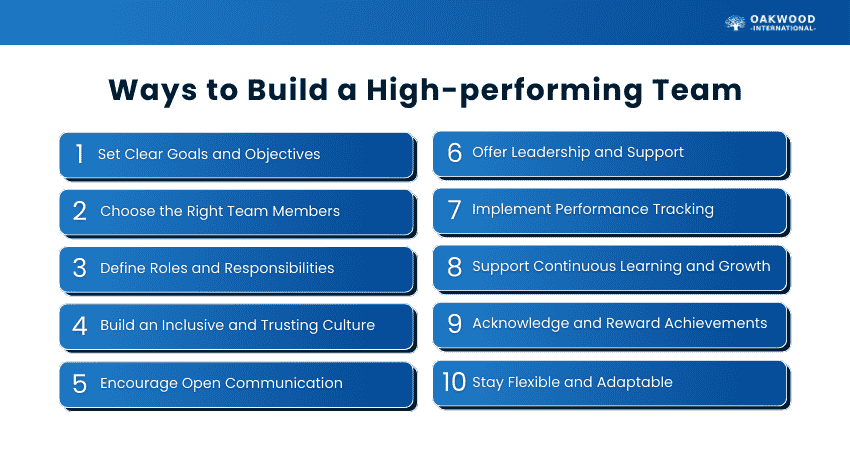
1) Set Clear Goals and Objectives
Start by setting Specific, Measurable, Achievable, Relevant, and Time-bound (SMART) goals. Ensure these objectives align with the broader business goals and are clearly understood by all team members.
2) Choose the Right Team Members
Choose individuals with the necessary skills and experience but also consider their potential for collaboration and cultural fit. A huge team with various skills and perspectives can enhance creativity and problem-solving.
3) Define Roles and Responsibilities
Clearly outline each team member's responsibilities and ensure they align with their strengths and career aspirations. Role clarity prevents duplication of effort, reduces misunderstandings, and ensures accountability across the team.
4) Build an Inclusive and Trusting Culture
Create a positive environment where open communication, trust, and mutual respect are foundational. Motivate team members to express their ideas and concerns freely. Regular team-building activities and open forums for feedback can help build this culture.
5) Encourage Open Communication
Implement robust communication practices and tools to facilitate seamless interaction, especially for geographically distributed teams. Regular meetings, updates, and check-ins help maintain alignment and cohesion.
6) Offer Leadership and Support
Effective leadership goes beyond task management; it involves providing vision, inspiration, and support. Leaders should mentor and coach team members, helping them grow individually and contribute effectively to the team.
7) Implement Performance Tracking
Set up systems to monitor and evaluate team performance against set goals. Use performance reviews to hold team members accountable, discuss development opportunities, and address any issues impacting the team's effectiveness.
8) Support Continuous Learning and Growth
Invest in development and training programmes to improve the team's skills and knowledge. Foster an environment of growth where continuous improvement is part of the team's ethos, learning from both successes and failures.
9) Acknowledge and Reward Achievements
Motivate team members by recognising and rewarding their contributions and achievements. While financial incentives are important, recognition, new opportunities, and personal growth can be equally motivating.
10) Stay Flexible and Adaptable
Be prepared to adapt the team structure, processes, and Networking Strategies as the organisation grows and external conditions change. Flexibility and resilience are crucial traits of a high-performing team.
Enhance your thinking approach to boost innovation, logic, and effective business solutions with our Creative and Analytical Thinking Training – Join now!
Most Common Types of High-performance Team Models
High-performance teams are structured to enhance performance and focus on delivering results. Organisations use various models to establish their identity. Here are some common examples:
1) Work Teams
Work teams handle specific areas like production and customer service. Comprised of employees with similar specialities, work teams are typically stable, full-time, and well-defined.

Found in both manufacturing and service sectors, they are usually managed by supervisors who make broader decisions. However, self-managing teams, where employees make decisions previously made by supervisors, are becoming more popular.
2) Virtual Teams
Virtual teams enable companies to assemble the best talent regardless of location. The global pandemic highlighted the strengths and challenges of virtual teams, where individuals collaborate across time, space, and organisational boundaries.

Using technology like Zoom and WebEx, virtual team members coordinate their work primarily through electronic communication, often without meeting face-to-face. This model allows organisations to access top talent and reduce travel costs.
3) Project Teams
These temporary teams are formed to complete specific projects or tasks with a clear end goal. Comprising individuals from various departments, project teams bring together different perspectives and expertise to handle complex challenges.

They focus on applying their skills and judgment to deliver high-quality results rather than engaging in repetitive tasks. This approach allows them to resolve complex problems, innovate effectively, and create greater value for the organisation.
4) Management Teams
Management teams provide guidance to subordinate teams and oversee business performance. Their authority comes from the hierarchical rank of their members, with executive management teams at the top, making Team Management essential for coordinating organisational objectives.

These teams set the strategic direction and manage performance by leveraging their collective expertise, ensuring the business runs efficiently and effectively. They also align resources and priorities to support long-term goals and drive sustainable organisational growth.
5) Parallel Teams
Created to handle functions beyond the formal organisational structure, parallel teams draw members from different work units or roles. Operating alongside the formal structure, they have limited decision-making authority but can make recommendations leading to broader changes.

Examples include task forces, employee improvement groups, and quality improvement teams that solve problems and drive improvements. These teams combine diverse skills and perspectives to identify issues, develop solutions, and enhance organisational performance.
Build Agile leadership skills to lead teams confidently and drive organisational success. Join our Agile Leadership Training now!
Benefits of Building High Performance Teams for Businesses
Building High Performance Teams offers numerous benefits that can significantly impact the organisation, team members, and the entire company. Here's how:
1) Enhanced Productivity and Efficiency
High Performance Teams consist of experts who work collaboratively to achieve their goals. By capitalising on each member's strengths and skills, these teams enhance productivity and efficiency, driving better results.
2) Challenging Outcomes
These teams are strategically focused on specific objectives, whether it's developing new products or creating a new Workplace Culture. Their collaborative approach enables them to overcome complex challenges and achieve remarkable outcomes.
3) Strengthened Trust and Workplace Engagement
Working together towards common goals encourages trust and engagement among team members. This sense of camaraderie boosts motivation and job satisfaction, leading to a more committed and cohesive team.
4) Realisation of Business Vision
High-performance teams help actualise the business vision by aligning their efforts with the company's broader goals. This alignment improves overall performance and helps achieve outcomes that further the business's success.
5) Effective Completion of Top Priority Goals
The focused collaboration of High-performance teams ensures they accomplish high-priority objectives efficiently. This leads to faster and more successful achievement of business goals.
6) Sustaining Consistent High Performance
To sustain High Performance, it's crucial to maintain clarity on expectations through a written team charter. Empowering team members by involving them in goal setting and being transparent about efforts fosters a collective commitment to continuous improvement.
Who's Responsible for Building High Performing Teams?
Building High Performing Teams requires clear goals, strong leadership, and effective performance systems that align employees with organisational success. As responsibility is shared among leaders, HR, managers, and employees, each plays a key role. Let's explore their roles in detail.
1) The Role of Senior Leaders
Senior leaders set the organisation's direction and define key goals. They clarify priorities, adapt strategies to changing needs, and model accountability and High Performance across teams and functions. Through effective coaching, they shape a culture focused on impact and results rather than just output.
2) The Role of HR
HR plays an important role in designing and supporting performance management systems. They align performance metrics with organisational goals, promote continuous feedback, and collaborate with leaders to create flexible programmes that enhance employee development, engagement, and business outcomes.
3) The Role of Managers
Managers connect organisational goals with daily team activities by clarifying expectations, building strong relationships, and providing regular feedback. They support employee growth through coaching, goal-setting, and resource allocation. Their insights help leaders and HR improve performance processes and strengthen team performance over time.
4) The Role of Employees
Employees actively contribute to building High Performing Teams through collaboration, accountability, and continuous improvement. By taking ownership of their roles, sharing ideas, and developing skills, they directly influence team success. Their engagement and commitment transform organisational goals into real results.
Be the leader everyone admires! Develop the skills to lead with our Leadership Skills Training and drive real results.
How to Measure the Performance of Your Teams?
Measuring team performance helps organisations evaluate how effectively teams achieve goals and work together. It highlights productivity, engagement, and improvement areas, helping leaders make informed decisions. Let's explore the key ways to measure team performance.
1) Set Clear Goals and Key Performance Indicators (KPIs): Define measurable goals aligned with organisational objectives. Use KPIs such as project completion rates, quality standards, customer satisfaction, and revenue impact to track progress.
2) Track Productivity and Output: Evaluate how efficiently teams complete tasks and meet deadlines using metrics like task timelines, workload balance, and deliverable quality.
3) Evaluate Collaboration and Communication: Assess teamwork through cross-team coordination, feedback quality, and meeting effectiveness to understand communication and collaboration levels.
4) Monitor Employee Engagement: Measure motivation and morale using surveys, participation rates, and retention data to understand employee engagement.
5) Assess Skill Development and Learning: Track training outcomes, certifications, and performance improvements to evaluate continuous learning and skill growth.
6) Analyse Feedback and Performance Reviews: Use feedback from managers, peers, and stakeholders to identify strengths, challenges, and improvement opportunities.
7) Measure Business Impact: Link team performance to business outcomes such as customer satisfaction, profitability, innovation, and growth to ensure meaningful impact.
Conclusion
Building strong teams requires clear goals, trust, collaboration, and continuous development. Understanding How to Build a High Performing Team helps organisations improve performance, engagement, and results. With the right leadership and culture, teams can adapt faster, stay motivated, and achieve long-term success.
Build strong leadership foundations and enhance decision-making with advanced Leadership Courses – Join now!
Frequently Ask Questions
What are the Five Dynamics of High Performing Teams?
High-performing teams are shaped by five key dynamics: psychological safety, dependability, clear roles and goals, meaningful work, and impact. These dynamics create a supportive environment where team members feel confident, aligned, and motivated to perform effectively.
What are the Key Elements of a High Performing Team?
A High Performing Team is built on clear goals, strong leadership, trust, open communication, defined roles, accountability, collaboration, and continuous learning. These elements help teams stay aligned, productive, and focused on achieving consistent results.
What is the Most Important Skill for a High Performance Team?
The most important skill for a High-performance team is effective communication. Clear and open communication helps team members share ideas, align goals, build trust, and resolve issues quickly. It strengthens collaboration, reduces misunderstandings, and enables teams to adapt faster and deliver better results.
Related Blogs
Didn’t Find What You’re Looking For?

Our commitment to excellence ensures an exceptional learning experience tailored to your professional development needs.


© Copyright 2026 - Oakwood International ™ - All rights reserved.


SUPER SALE
 Get Amazing Discounts
And Deals
Get Amazing Discounts
And Deals