

 Back
Back


 Back to Catagories


Table of Contents


 + 44 7452
122728
+ 44 7452
122728
 11-Jul-2026
David Walter
Not every workplace thrives on constant change. Many organisations succeed by following clear processes, defined roles, and consistent ways of working. That's where Bureaucratic Leadership plays an important role.
This leadership style focuses on structure, clarity, and established rules to achieve reliable results. Curious to know whether this approach is the right fit for your organisation? This blog explores what is Bureaucratic Leadership, its key characteristics, advantages, and real-world examples to help you understand its impact in today's workplace. Let's get started!
What is Bureaucratic Leadership?
Bureaucratic Leadership is a leadership style based on formalised rules, defined responsibilities, a structured chain of command, and established procedures to guide daily operations. Leaders make decisions by following predefined policies, ensuring consistency, accountability, and compliance across the organisation.
Rather than encouraging frequent changes or individual discretion, Bureaucratic Leadership focuses on maintaining order, fairness, and operational stability. It also helps reduce errors, support standardised performance, and create predictable outcomes. This leadership style is particularly effective in workplaces where safety, quality, and regulatory compliance are top priorities.

Key Characteristics of Bureaucratic Leadership
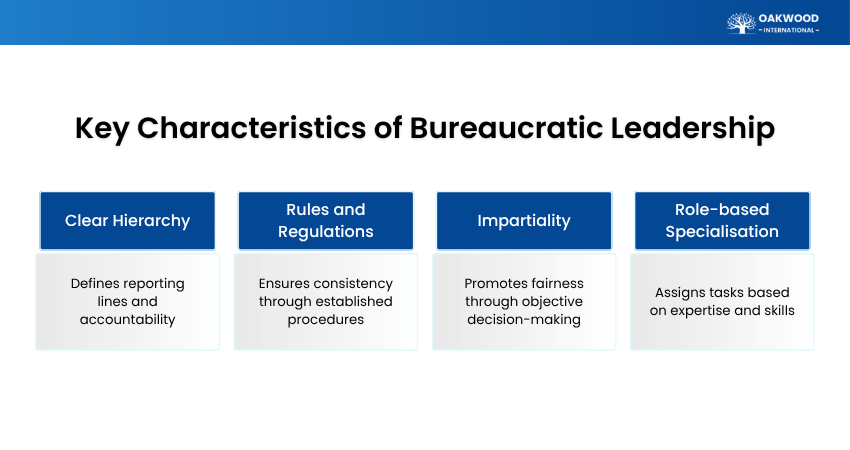
A strong Bureaucratic Leader creates stability by ensuring that everyone follows rules and procedures. Their leadership style is defined by characteristics that promote consistency and operational efficiency. The following are the key characteristics of Bureaucratic Leadership:
1) Clear Hierarchy
Bureaucratic Leadership style is built on a clearly defined chain of command, where every employee has a specific reporting line. Responsibilities and decision-making authority are distributed across different management levels, ensuring an organised flow of communication.
This structure helps employees understand who is responsible for approvals, guidance, and supervision. Moreover, it improves accountability, reduces confusion, and enables managers to coordinate teams effectively while maintaining operational control.
2) Rules and Regulations
Bureaucratic organisations operate through well-established rules and standard procedures that guide everyday activities. These policies set proper expectations for employee behaviour, workplace practices, and organisational processes.
Following the same procedures across the organisation creates consistency and reduces uncertainty. Standardised workflows also improve service quality, minimise errors, and help organisations comply with legal and regulatory requirements.
3) Impartiality
Bureaucratic leaders make decisions based on organisational policies rather than personal opinions or relationships. As a result, employees are treated fairly and decisions remain objective across the organisation.
This impartial approach reduces favouritism and encourages equal treatment across all levels of the organisation. Employees are evaluated on their performance and compliance with established standards, helping to build trust and professionalism.
4) Role-based Specialisation
In Bureaucratic Leadership, responsibilities are assigned according to each employee's expertise, qualifications, and job function. Every role has clearly defined duties, allowing individuals to focus on specific tasks.
This division of responsibilities improves efficiency and helps employees develop specialised knowledge in their area of work. As teams become more skilled in their respective roles, organisations benefit from higher productivity and more consistent outcomes.
Empower your leadership potential with the CMI Level 5 Award in Management and Leadership Training – Join now!
Advantages of Bureaucratic Leadership
Bureaucratic Leadership offers several advantages for organisations that prioritise structure, consistency, and compliance. Some of its key benefits include:
1) Predictability: Following established processes creates a stable and reliable workflow, helping teams perform consistently.
2) Operational Efficiency: Clearly defined roles and specialised responsibilities improve productivity and support efficient workflows.
3) Organisational Stability: Fixed rules and procedures maintain continuity, even during leadership or organisational changes.
4) Standardisation: Uniform processes ensure tasks are completed consistently, supporting quality, accuracy, and compliance across the organisation.
5) Fairness and Impartiality: Applying the same policies and procedures to everyone promotes fair and objective decision-making.
Disadvantages of Bureaucratic Leadership
While Bureaucratic Leadership provides structure and consistency, it also has certain limitations. So, here are the disadvantages of Bureaucratic Leadership:
1) Resistance to Innovation: A strong focus on established processes may discourage change, making it harder for organisations to adapt and stay competitive.
2) Inflexibility: Rigid rules and hierarchies can make it difficult for organisations to respond quickly to change.
3) Slow Decision-making: Decisions often require multiple levels of approval, which can delay action and reduce agility.
4) Reduced Employee Autonomy: Employees have limited freedom to make independent decisions, as they are expected to follow established rules and procedures.
When Should Bureaucratic Leadership be Used?
Bureaucratic Leadership is most effective in environments where consistency, compliance, and clearly defined processes are essential. The following situations highlight when this leadership style delivers the best results:
1) In Highly Regulated Industries
Industries such as healthcare, banking, government, and aviation operate under strict legal and regulatory requirements. Bureaucratic Leadership style helps ensure employees follow established procedures, reducing compliance risks and maintaining high operational standards.
2) Where Safety is a Priority
Workplaces that involve hazardous equipment, sensitive information, or public safety require strict adherence to rules. Bureaucratic Leadership helps minimise risks by ensuring employees consistently follow safety protocols and operational procedures.
3) For Routine and Standardised Operations
Organisations that perform repetitive tasks benefit from clearly defined workflows and responsibilities. Standardised processes improve efficiency, reduce errors, and ensure consistent service or product quality.
4) In Large and Complex Organisations
Large organisations with multiple departments require clear reporting structures and defined responsibilities. Bureaucratic Leadership supports coordination and consistent decision-making across different teams and management levels.
5) During Compliance and Audit Requirements
When organisations must meet legal, regulatory, or industry standards, Bureaucratic Leadership provides the structure needed to maintain accurate documentation and consistent adherence to established policies and procedures.
6) Where Clear Roles and Responsibilities are Essential
Projects or organisations with specialised job functions benefit from clearly defined responsibilities. Bureaucratic Leadership helps employees understand their duties, improves coordination, and reduces confusion in day-to-day operations.
Examples of Bureaucratic Leadership
Understanding real-world examples makes it easier to see how Bureaucratic Leadership works in practice. The following leaders demonstrate how structure, discipline, and established procedures can drive organisational success:
1) Alfred Sloan (General Motors)
Alfred Sloan transformed General Motors into a highly structured organisation by combining decentralised business divisions with centralised financial oversight and company policies. He established clear reporting structures and defined responsibilities to improve coordination across the company.
He also introduced standardised procedures and structured decision-making processes that promoted consistency, accountability, and operational efficiency. His systematic approach became a leading example of Bureaucratic Leadership in the business world.
2) Robert McNamara (Ford Motor Company / U.S. Department of Defence)
Robert McNamara introduced a highly structured, data-driven approach to managing large organisations. At both Ford and the Pentagon, he relied on performance metrics, formal hierarchies, and standardised procedures to guide decision-making and improve operational efficiency.
Rather than depending on personal judgement or leadership charisma, McNamara focused on systems, processes, and measurable outcomes. His emphasis on discipline, formal systems, and evidence-based management makes him a widely recognised example of Bureaucratic Leadership.
3) Harold Geneen (ITT Corporation)
Harold Geneen established a highly structured management system during his time at ITT Corporation. He introduced detailed reporting processes, standardised procedures, and comprehensive policy guidelines to ensure consistency across the company's subsidiaries.
Instead of relying on personal influence, Geneen focused on formal systems, operational discipline, and centralised oversight. His emphasis on structured processes and administrative control makes him a recognised example of Bureaucratic Leadership in the corporate sector.
4) Shinji Sogō of the Japanese National Railways
Sinji Sogō led the Japanese National Railways during the development of the first bullet train, Tokaido Shinkansen. He successfully advanced the project despite significant internal resistance, using strategic planning and strong organisational influence to gain approval.
Although he worked within a highly bureaucratic organisation, his leadership was driven more by vision, determination, and political skill than by strict adherence to established procedures. His emphasis on discipline, consistency, and organisational control makes him a recognised example of Bureaucratic Leadership.
Advance your leadership capabilities with the CMI Level 5 Diploma in Management and Leadership Training – Register now!
What is the Difference Between Bureaucratic and Autocratic Leadership?
Understanding the differences between Bureaucratic and Autocratic Leadership can help organisations choose the most effective approach for their goals. Bureaucratic Leadership relies on established rules, policies, and procedures, whereas autocratic leadership places decision-making authority primarily in the hands of a single leader. The comparison below outlines their key distinctions:
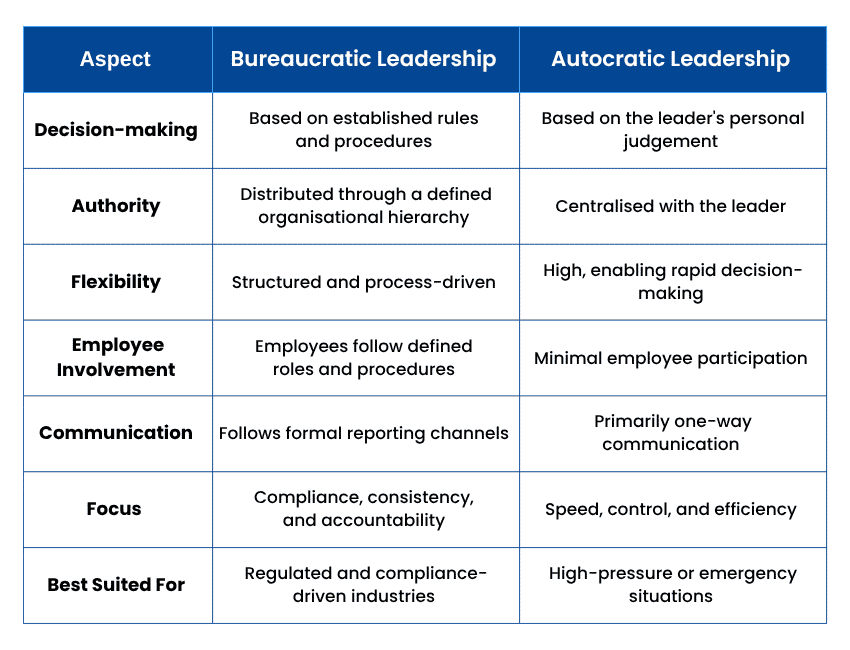
1) Decision-making: Bureaucratic Leadership follows established rules, policies, and procedures to ensure consistency and fairness. In contrast, Autocratic Leadership relies on the leader's personal judgement, with decisions made quickly and without following extensive organisational processes.
2) Authority: Bureaucratic leaders operate within a structured hierarchy and make decisions according to organisational policies. However, autocratic leaders hold centralised authority, retaining full control over decisions with little or no input from employees.
3) Flexibility: Bureaucratic Leadership prioritises consistency, compliance, and standardised processes, which can reduce flexibility. On the other hand, autocratic leadership is adaptable in urgent situations, allowing leaders to respond quickly when immediate action is required.
4) Employee Involvement: In Bureaucratic Leadership, employees perform clearly defined roles while following established procedures. Under autocratic leadership, employees have limited involvement in decision-making, as the leader directs tasks and determines outcomes.
5) Best Suited for: Bureaucratic Leadership is ideal for regulated, process-driven industries such as healthcare, banking, and government. Autocratic leadership is better suited to crisis situations, military operations, or environments where rapid decisions and strong central control are essential.
Conclusion
Bureaucratic Leadership emphasises structure, clear responsibilities, and established procedures to ensure consistency and accountability. It is particularly effective in industries where compliance, accuracy, and reliability are essential. Although it may limit flexibility and innovation, it remains a valuable leadership style when stability, standardisation, and operational efficiency are of paramount importance.
Strengthen your leadership and management capabilities with the CMI Level 5 Training – Join now!
Frequently Ask Questions
What is the Theory of Bureaucratic Leadership?
What are the Four Types of Leadership Styles?
The four main leadership styles are:
a) Autocratic
b) Democratic
c) Laissez-faire
d) Transformational
Each differs in how leaders make decisions, involve employees, delegate responsibilities, and inspire teams. The most effective style depends on the organisation's goals, culture, and specific workplace challenges.
Is Bureaucratic Leadership Suitable for Modern Organisations?
Bureaucratic Leadership may be less suitable for fast-paced organisations that require flexibility and innovation. However, it remains highly effective in regulated industries such as healthcare, finance, construction, and government, where standard procedures and compliance are essential for safety and operational consistency.
Related Blogs
Didn’t Find What You’re Looking For?

Our commitment to excellence ensures an exceptional learning experience tailored to your professional development needs.


© Copyright 2026 - Oakwood International ™ - All rights reserved.


SUPER SALE
 Get Amazing Discounts
And Deals
Get Amazing Discounts
And Deals