

 Back
Back


 Back to Catagories


Table of Contents


 + 44 7452
122728
+ 44 7452
122728
 24-Sep-2026
Maria Thompson
Ever wondered why some workplaces feel productive and well-managed while others struggle with communication and employee satisfaction? The difference often comes down to professionals with strong HR Skills. From hiring talented employees to managing workplace challenges, skills for HR help create positive and successful work environments.
Today, Human Resources (HR) professionals are expected to do more than recruitment and administration. Companies value individuals with strong HR Skills who can communicate effectively, solve problems, support employees, and adapt to workplace changes. Let’s explore the key skills needed for workplace success!
What are HR Skills?
HR Skills are the abilities and knowledge used by Human Resources (HR) professionals to manage employees and support organisational operations effectively. These skills help HR teams handle recruitment, employee training, performance management, workplace communication, and employee relations while maintaining a positive work environment.
Professionals such as HR Managers, recruiters, HR Specialists, and Training Managers use these abilities to hire suitable candidates, support employee development, and manage workplace challenges effectively. Strong HR capabilities also improve teamwork, communication, and overall organisational performance.

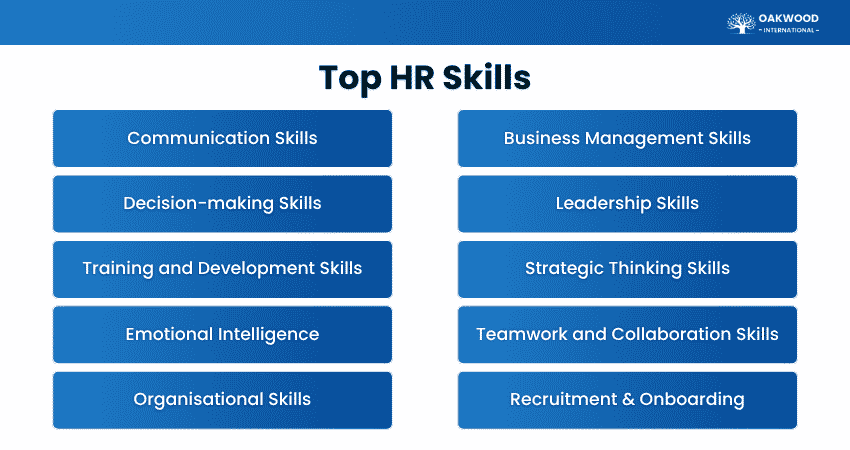
Top HR Skills Every Professional Needs
Here are some of the essential skills you must have:
1) Communication Skills
HR professionals need to inform candidates about the interview process, plan and implement the company's onboarding process, and communicate company policies to employees. This requires excellent verbal communication skills. Additionally, good written communication skills are important for creating policy handbooks, sending promotion emails, and releasing memos.
2) Decision-making Skills
HR involves making crucial decisions, such as during downsizing or recruitment. Choosing the right candidate requires intuition, experience, and strategy.
3) Training and Development Skills
HR professionals plan training sessions to help employees improve their skills, supporting their career growth. For example, they might arrange leadership and time management sessions to boost teamwork and productivity.
4) Emotional Intelligence
HR professionals use emotional intelligence to understand employee feelings and handle workplace situations effectively. For example, they may resolve conflicts calmly and support employees during stressful situations to maintain a positive work environment.
5) Organisational Skills
HR professionals handle many responsibilities, such as recruitment and performance reviews. They need to organise documents systematically to boost efficiency through
Organisational Skills
.
6) Business Management Skills
HR professionals must address organisational challenges, understand employee rights and hiring laws, manage diversity and inclusion, and create benefits packages.
7) Leadership Skills
HR professionals play an important role in guiding employees towards success and developing future leaders. They foster leadership throughout the organisation, creating problem solvers at all levels.
8) Strategic Thinking Skills
HR professionals leverage strategic thinking to give the company a competitive edge by investing in employees. They understand the strategic needs of each department and focus on retaining valuable employees.
Align HR strategies with business goals and drive organisational growth through the
HR Strategy Training
– Register now!
9) Teamwork and Collaboration Skills
HR professionals work as a team with colleagues and managers to create the best workplace for employees. Internal collaboration benefits both HR and the organisation.
10) Recruitment & Onboarding
HR professionals manage recruitment and onboarding to help organisations hire suitable candidates and support new employees effectively. This process helps employees adjust to the workplace smoothly and improves overall productivity.
11) Risk Management Skills
HR's risk management team ensures a safe working environment as part of
Environmental Social Governance (ESG)
initiatives. For example, in healthcare,, HR professionals identify hazardous items and plan for their safe disposal. They also create safety handbooks and provide safety training to employees.
12) Intercultural Sensitivity and Language Skills
HR professionals in multinational companies work with employees from diverse cultural backgrounds. They need to be sensitive to different cultures, understand various communication styles, and have the language skills to interact effectively with people from different countries.
13) Flexibility and Adaptability
HR professionals use flexibility and adaptability to respond effectively to changing workplace situations, employee needs, and organisational goals. These abilities help them manage challenges, support teams, and adjust to new processes smoothly.
14) Maintaining Confidentiality
HR professionals maintain confidentiality to protect sensitive employee and organisational information. This helps build trust, ensure privacy, and support a professional workplace environment.
15) Technical Proficiency
HR professionals use technical proficiency to manage HR software, employee records, communication tools, and recruitment systems efficiently. This skill improves accuracy, productivity, and daily HR operations.
Develop strategic HR expertise to lead teams and support organisational growth with the
Certified HR Manager Training
– Join today!
16) Negotiation Skills
HR professionals use negotiation skills to handle workplace discussions, resolve disagreements, and achieve fair outcomes for employees and organisations. These skills support better communication and professional relationships.
17) Conflict Resolution and Mediation
HR professionals use conflict resolution and mediation skills to handle workplace disagreements fairly and professionally. These abilities help maintain positive relationships and create a healthy work environment.
18) Knowledge of Employment Laws and HR Practices
HR professionals apply knowledge of employment laws and HR practices to ensure organisations follow workplace regulations and ethical standards. This helps protect employee rights and reduce legal risks.
19) Change Management Skills
HR professionals use change management skills to support employees and organisations during workplace changes and transitions. These abilities help improve communication, reduce resistance, and ensure smoother adaptation.
20) Coaching and Advising Skills
HR professionals use coaching and advising skills to guide employees, support career development, and improve workplace performance. These abilities help employees build confidence and achieve professional growth.
Conclusion
Developing strong HR Skills is essential for managing employees effectively and supporting organisational growth. From communication and leadership to recruitment and adaptability, these abilities help professionals succeed in modern workplaces. Continuous learning and upskilling can improve career opportunities, strengthen workplace relationships, and help HR professionals stay competitive in an evolving business environment.
Grow your HR expertise and lead teams with greater confidence with the HR Leadership Courses – Join today!
Frequently Ask Questions
What are the 5 C's of HR?
The 5 C’s of HR include:
a) Culture: Builds a positive work environment
b) Communication: Improves teamwork and interaction
c) Compliance: Ensures workplace rules are followed
d) Compensation: Manages salaries and benefits
e) Career Development: Supports employee growth
Can HR Skills be Learned Online?
Yes, HR Skills can be learned online through courses and training programmes. Oakwood International HR Leadership Courses provide professionals with the knowledge and practical skills needed for recruitment, communication, and employee management.
What is the Difference Between Soft HR Skills and Technical HR Skills?
Soft HR Skills focus on communication, leadership, emotional intelligence, and relationship management to support employees effectively. Technical HR Skills involve recruitment, payroll, compliance, HR software, and performance management, used to handle operational HR tasks efficiently.
Related Blogs
Didn’t Find What You’re Looking For?

Our commitment to excellence ensures an exceptional learning experience tailored to your professional development needs.


© Copyright 2026 - Oakwood International ™ - All rights reserved.


SUPER SALE
 Get Amazing Discounts
And Deals
Get Amazing Discounts
And Deals