

 Back
Back


 Back to Catagories


Table of Contents


 + 44 7452
122728
+ 44 7452
122728
 24-Sep-2026
Gary Moore
Performance conversations in the workplace often get tangled, as Performance Management and Performance Appraisal are frequently mistaken for the same thing. When you look closer, you’ll see they play very different roles in shaping employee growth. One is an ongoing journey of coaching and alignment, while the other is a moment-in-time evaluation.
In this blog, we break down the key differences between Performance Management vs Performance Appraisal. These help organisations build stronger teams, improve productivity and create a culture of ongoing success. Read on to learn how to evaluate and manage performance more effectively.
What is Performance Management?
Performance Management is an ongoing process through which an organisation makes sure that the employees achieve the desired level of performance via support and appropriate tools or technologies. It involves continuous interaction between the organisation and the employee to monitor progress across key performance areas.
Features of Performance Management
Here are the key features of Performance Management:
a) Ongoing: Performance Management is a continuous, year-round process supported by regular reviews and check-ins.
b) Proactive: It focuses on forward-looking actions. It identifies what can be improved or achieved rather than only reviewing past performance.
c) Strategic: Individual contributions are aligned with broader objectives to ensure a unified and purpose-driven approach.
d) Developmental: Emphasis is placed on learning and skill development to support employee growth and career progression.
e) Collaborative: It encourages active involvement from employees, Managers and the organisation. This fosters a shared responsibility for performance and success.

What is a Performance Appraisal?
Performance Appraisal is the process by which a Manager evaluates an employee’s work quality and their overall productivity. It involves comparing an individual’s performance against the organisation’s goals to gauge progress and identify areas that need improvement. Performance Appraisal is typically one component of the broader Performance Management process, although some organisations conduct appraisals as standalone evaluations.
Features of Performance Appraisal
Here are the main features of Performance Appraisal:
1) Periodic: Appraisals are typically conducted at set intervals throughout the year.
2) Reflective: They review past performance while also considering future goals and improvements.
3) Formal: The results can influence decisions related to salary increases and promotions.
4) Evaluative: Employees are assessed against predefined criteria to provide objective, evidence-based feedback.
5) Structured: Appraisals follow a consistent format, with outcomes recorded for future reference.
Difference Between Performance Management and Performance Appraisal
Here are the main distinctions between Performance Management vs Performance Appraisal:
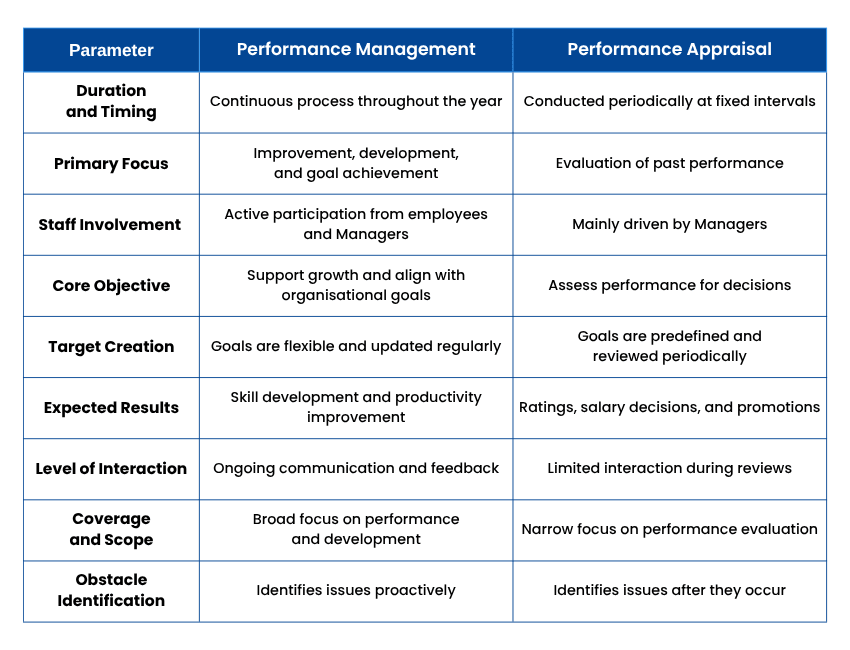
Let’s explore these differences in detail:
1) Duration and Timing
The key difference between Performance Management and Performance Appraisal lies in their timing and frequency. Performance Appraisals are typically conducted once or twice a year, providing a defined period to review an employee’s contributions. In contrast, continuous Performance Management is ongoing, involving regular check-ins, real-time feedback, and continuous development throughout the year.
2) Primary Focus Areas
Performance Appraisals are centred on evaluating past performance, highlighting what an employee has achieved and reflecting on progress towards broader goals. On the other hand, continuous Performance Management emphasises ongoing improvement, focusing on actions and strategies that support future growth and success.
3) Staff Involvement
Performance Appraisals are typically conducted by line managers, with support from human resources teams who provide guidance and maintain organisational records.
The data used typically includes:
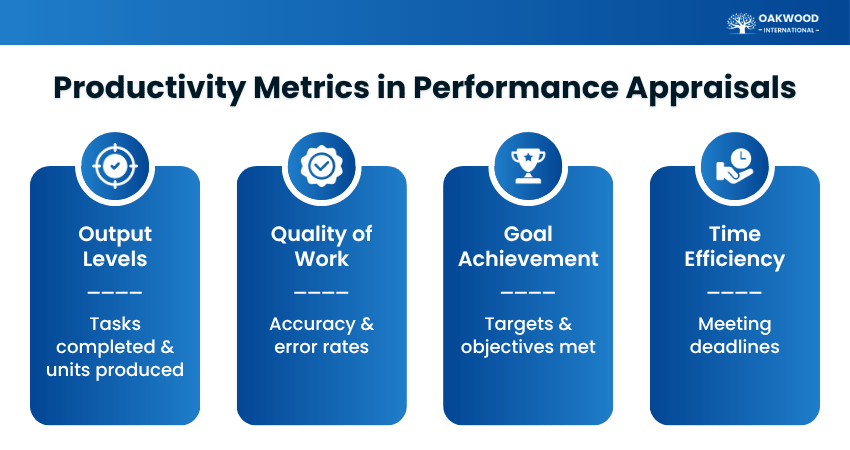
a) Productivity Metrics: These are the output levels or sales performance
b) Attendance Records: These shed light on the working hours attended and absences
c) Employee Morale Surveys: These offer insights into workplace satisfaction
d) Customer Feedback: This helps gauge levels of customer satisfaction
e) Compensation Details: This includes salary, commissions and overall earnings data
These are some common productivity metrics:
4) Core Objectives
Both Performance Appraisal and Performance Management are designed to boost employee performance and contribute to the overall business growth. Performance Appraisal mainly focuses on evaluating and measuring an employee’s performance at a given point in time. Conversely, continuous Performance Management emphasises ongoing support and development. This helps employees improve their performance consistently over time.
5) Target Creation
Both Performance Appraisal and Performance Management play a key role in setting employee targets. Performance Appraisals rely on data-driven insights, evaluating individual performance to create tailored development plans for each employee. Common metrics used to define targets include:
a) Sales Volume: This is the number of products sold within a given period
b) Revenue: This is the income generated from sales
c) Sales Actions: These are activities undertaken regardless of outcome
d) Conversion Rate: This is the percentage of potential customers converted into actual sales
Learn how to align the right people to the right roles with our Workforce Resource Planning Training - Register now!
6) Expected Results
The outcomes of Performance Management and Performance Appraisal can differ based on their respective objectives. Performance Appraisal focuses on evaluating performance, recording achievements, and setting direction for future improvement. In contrast, continuous Performance Management aims to develop capabilities and strengthen employee engagement. This ultimately contributes to overall organisational success.
7) Level of Interaction
Performance Appraisal is typically a formal process in which a Manager delivers structured feedback to an employee. On the other hand, continuous Performance Management encourages open, ongoing communication. This fosters a two-way dialogue in which feedback is regularly shared and reflects the organisation’s commitment to supporting its employees.
8) Coverage and Scope
Performance Management is a comprehensive strategic framework that covers aspects like goal setting, feedback, skill development and career progression planning. In comparison, Performance Appraisal is a more focused component within this framework, with a narrower scope. It typically involves documented reviews that may include ratings used to evaluate employee progress.
9) Obstacle identification
Both Performance Appraisal and Performance Management help identify challenges that may affect an employee’s performance. Performance Appraisals use trend data to highlight gaps across different competencies. For instance, if an employee performs well in most areas but struggles with a specific product, this indicates a clear obstacle.
In contrast, Performance Management takes a more personalised approach by encouraging direct discussions with employees. This helps uncover underlying reasons behind performance issues, such as a lack of understanding or personal concerns.
Build a workforce that thrives by discovering and retaining top talent through our Talent Management Training - Sign up now!
Key Similarities Between Performance Management and Performance Appraisal
While Performance Management vs Performance Appraisal differ in approach, they share several important similarities:
1) They Set Goals and Track Progress: Both approaches focus on establishing clear targets and monitoring progress towards achieving them. These goals are most effective when they follow the SMART criteria: Specific, Measurable, Achievable, Relevant and Time-bound.
2) They Identify Challenges and Address Them: Both methods help recognise performance gaps and obstacles. Performance Management takes a broader organisational view while Performance Appraisal focuses on individual strengths and areas for improvement.
3) They Measure Performance Outcomes: Performance in both systems is evaluated using metrics, KPIs and other measurable indicators to track progress and success against defined objectives.
4) They Aim to Improve Everyday Performance: Ultimately, both approaches are designed to enhance day-to-day employee performance, contributing to overall organisational effectiveness and productivity.
5) They Support High-performing Teams: Together, they help build teams that collaborate effectively, stay engaged, understand expectations clearly, and possess the confidence and skills needed to deliver strong results.
Continuous Performance Management vs Performance Appraisal: Which is Better?
Comparing continuous Performance Management and Performance Appraisal as if one is better than the other misses the point. When used together, they complement each other and deliver better results. Performance Appraisals work best when they are part of an ongoing Performance Management process.
On their own, appraisals can sometimes make employees feel judged or disconnected, especially without regular feedback and communication. Continuous Performance Management provides regular conversations, context, and support, making appraisals fairer and more meaningful. Together, they create a balanced approach where appraisals act as checkpoints to review progress and plan the next steps.
Conclusion
In the end, the main thing to understand about Performance Management vs Performance Appraisal is that they are not rivals but partners in driving success. Together, they create a balanced approach: one guiding continuous growth, the other measuring progress. By combining both effectively, organisations can empower employees, build a workplace where performance thrives and long-term success becomes achievable.
Build stronger teams through the art of people leadership. Sign up for our People Management Courses now!
Frequently Ask Questions
What are the Five Stages of Performance Management?
The five stages of Performance Management typically include:
1) Planning: It involves setting clear goals and expectations
2) Monitoring: It tracks progress regularly
3) Developing: It focuses on improving skills
4) Reviewing: It evaluates overall performance
5) Rewarding: It recognises achievements to motivate employees
How is a PMS Different From Appraisals?
A Performance Management System (PMS) is a continuous process that focuses on ongoing feedback and goal alignment. In contrast, appraisals are periodic evaluations that assess past performance. PMS is broader and proactive, while appraisals are more structured and focused on measurement.
What are the Four Pillars of PMS?
The four key pillars of a Performance Management System (PMS) are goal setting, continuous feedback, performance evaluation and employee development. These pillars ensure that employees understand expectations, receive regular guidance, are assessed fairly and are supported in improving their skills and performance.
Related Blogs
Didn’t Find What You’re Looking For?

Our commitment to excellence ensures an exceptional learning experience tailored to your professional development needs.


© Copyright 2026 - Oakwood International ™ - All rights reserved.


SUPER SALE
 Get Amazing Discounts
And Deals
Get Amazing Discounts
And Deals