

 Back
Back


 Back to Catagories


Table of Contents


 + 44 7452
122728
+ 44 7452
122728
 24-Sep-2026
Veronica Davis
Ever wondered who handles recruitment, solves employee issues, manages workplace policies, and keeps organisations running smoothly behind the scenes? While many people assume all HR professionals perform the same role, the reality is quite different. The discussion around HR Specialist vs HR Generalist often confuses both businesses and professionals because these roles support organisations in very different ways.
From hiring talented employees to managing payroll, training, and employee relations, both roles play a major part in building successful workplaces. However, their responsibilities, expertise, and career paths can vary significantly. In this blog, you’ll explore the key differences and similarities between HR Specialist vs HR Generalist roles and discover which option best suits different business needs and career goals. Let's dive in!
What is an HR Specialist?
An HR Specialist is a Human Resources professional who focuses on one specific area of HR rather than handling all HR functions. They develop expert knowledge and skills in specialised fields such as recruitment, payroll, employee relations, training and development, compensation, or HR compliance.
HR Specialists are commonly found in medium and large organisations where HR responsibilities are divided into separate departments. Their main role is to manage specialised tasks within their area of expertise. For example, a Recruitment Specialist focuses on hiring and onboarding employees, while a Payroll Specialist manages salaries and employee benefits.

What is an HR Generalist?
An HR Generalist is a Human Resources professional who manages a wide range of HR functions across an organisation. Instead of focusing on one specific area, they handle multiple responsibilities such as recruitment, employee relations, onboarding, training support, payroll coordination, and policy implementation.
HR Generalists are commonly found in small and medium-sized businesses where one HR professional oversees several HR activities. Their broad knowledge helps organisations manage daily HR operations efficiently while supporting employees and maintaining workplace policies. They also act as a key link between employees and management within the organisation.
Key Differences Between HR Specialists and HR Generalists
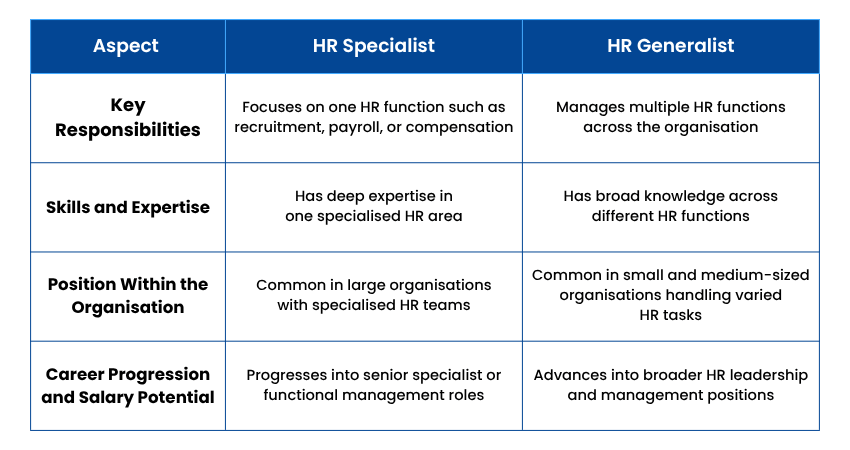
When comparing HR Specialist vs HR Generalist roles, several important differences become clear. Although both belong to Human Resources, they differ mainly in responsibilities, expertise, organisational roles, and career growth opportunities. The difference between HR Generalist and HR Specialist roles is explained below:
1) Scope of Responsibilities
One of the main differences between HR Specialists and HR Generalists is the scope of their responsibilities. HR Specialists focus on one specific HR function and manage specialised tasks within that area. For example, a Benefits Specialist manages employee insurance and retirement plans, while a Recruitment Specialist focuses on hiring and onboarding employees.
In contrast, HR Generalists handle multiple HR activities across different functions. Their responsibilities may include recruitment, employee relations, payroll coordination, policy implementation, and training support. Rather than specialising in one area, they ensure the smooth functioning of overall HR operations within the organisation.
2) Specialised Knowledge vs Broad Knowledge
HR Specialists develop deep expertise in one specific HR field. They stay updated on industry trends, regulations, tools, and best practices related to their specialisation. For example, a Learning and Development Specialist understands training strategies, employee development methods, and learning systems in detail.
HR Generalists, however, require broad knowledge across multiple HR functions. They understand how different HR activities work together and can support several areas of employee management. While they may not have advanced expertise in one field, their wider knowledge helps them manage day-to-day HR operations effectively.
3) Role in Organisational Structure
HR Specialists are more common in large organisations where HR departments are divided into separate teams. Different specialists manage recruitment, compensation, training, compliance, or employee relations individually. This structure allows businesses to benefit from dedicated expertise in each HR area.
HR Generalists are usually found in small and medium-sized organisations where one HR professional handles several responsibilities. They often work closely with employees and management while overseeing multiple HR functions within the business on a daily operational basis.
Develop effective HR strategies to support long-term business and people's goals with the
HR Strategy Training
– Join now!
4) Career Progression and Salary Potential
The career paths of HR Specialists and HR Generalists can differ based on their expertise and responsibilities. HR Specialists often progress within their chosen field and move into senior specialist or managerial roles such as Compensation Manager, Talent Acquisition Manager, or Learning and Development Manager. According to Glassdoor, HR Specialists in the UK earn an average salary of approximately £41K per year.
HR Generalists often advance into broader leadership roles such as HR Manager, HR Business Partner, or HR Director. Their experience across multiple HR functions supports organisational strategy and operations. According to Glassdoor, HR Generalists earn an average salary of around
£38K
per year in the UK, though salaries vary by industry, company size, and experience.
Key Similarities Between HR Specialists and HR Generalists
Although the HR Specialist vs HR Generalist comparison highlights several differences, both roles also share many similarities. They play a vital role in managing employees, improving workplace environments, and ensuring effective HR operations across organisations. Some key similarities are outlined below:
1) Common HR Duties
Despite their differences, both HR Specialists and HR Generalists share several core HR responsibilities. Both roles help organisations manage employees, support workplace policies, and maintain professional standards within the business.
Some common HR duties include:
a) Supporting recruitment and onboarding
b) Maintaining employee confidentiality
c) Assisting with employee relations
d) Supporting workplace culture and company values
e) Helping attract and retain employees
Both roles contribute to creating positive employee experiences and improving workplace efficiency.
2) Importance of Interpersonal Skills
Strong interpersonal skills are essential for both HR Specialists and HR Generalists. Since they interact with employees at different levels of the organisation, they must communicate clearly and handle workplace situations professionally.
Important skills include communication, empathy, problem-solving, teamwork, and conflict resolution. For example, a Recruitment Specialist builds relationships with candidates, while an HR Generalist helps resolve employee concerns professionally.
3) Supporting Business Growth
Both HR Specialists and HR Generalists contribute directly to business growth and organisational success. Effective HR management helps companies improve employee performance, increase productivity, and maintain a positive work environment.
For example, an HR Specialist may improve recruitment or compensation strategies, while an HR Generalist may support employees onboarding and daily HR operations. Although their approaches differ, both roles help organisations achieve long-term business goals.
4) Learning and Professional Development
Continuous learning is important for both HR Specialists and HR Generalists because workplace trends and employment laws continue to evolve. HR professionals regularly attend training programmes, workshops, and certifications to improve their skills and knowledge.
Professional development helps HR professionals stay updated with industry changes and organisational needs. It also supports career growth and helps both roles manage employees, workplace culture, and HR operations more effectively.
Transform HR data into actionable insights for stronger organisational performance through the
HR Analytics Course
- Register now!
HR Specialist vs HR Generalist: Which HR Role is Right for You?
When comparing HR Specialist vs HR Generalist roles, HR Generalists manage multiple HR functions such as recruitment, payroll, onboarding, and employee relations, making them ideal for small and medium-sized organisations. They are best suited for professionals who enjoy variety and multitasking.
In the HR Generalist vs HR Specialist comparison, HR Specialists focus on one specific HR area, such as Talent Acquisition, Compensation, or Learning and Development. They are commonly found in larger organisations and are ideal for professionals who prefer specialised expertise and structured responsibilities.
Conclusion
Understanding HR Specialist vs HR Generalist roles helps businesses build stronger HR teams and helps professionals choose suitable career paths. While Specialists provide deep expertise in specific areas, Generalists manage broader HR operations. Both roles play an important part in creating productive workplaces, improving employee experiences, and supporting long-term business success.
Develop confident HR leaders for high-performing organisational growth with the HR Leadership Courses – Join today!
Frequently Ask Questions
Is an HR Generalist Senior to an HR Specialist?
Not necessarily. HR Generalists and HR Specialists are different roles with different responsibilities. Seniority depends on experience, expertise, organisational structure, and job level rather than the role title itself.
What are the Big 4 Functions of HR?
The Big 4 functions of HR are recruitment and staffing, training and development, performance management, and compensation and benefits. These functions help organisations hire employees, improve skills, manage performance, and support employee satisfaction through salaries and workplace benefits.
Which HR Role Has the Highest Salary?
Senior HR roles such as CHROs, HR Directors, Talent Acquisition Heads, and Compensation Directors are among the highest-paying HR positions in the UK. According to Glassdoor, CHRO salaries can range from £44K to £2L per year, with higher earnings possible in large organisations and competitive industries.
Related Blogs
Didn’t Find What You’re Looking For?

Our commitment to excellence ensures an exceptional learning experience tailored to your professional development needs.


© Copyright 2026 - Oakwood International ™ - All rights reserved.


SUPER SALE
 Get Amazing Discounts
And Deals
Get Amazing Discounts
And Deals