

 Back
Back


 Back to Catagories


Table of Contents


 + 44 7452
122728
+ 44 7452
122728
 21-Sep-2026
Veronica Davis
Choosing a career in Human Resources can feel exciting, but also a little confusing when roles sound similar yet differ in practice. One common question professionals face in the HR Business Partner vs HR Manager debate is understanding how these roles differ. Both play a key part in managing people, but their focus, responsibilities, and impact vary significantly.
In the HR Business Partner vs HR Manager comparison, one role focuses on strategy and business growth, while the other ensures smooth daily HR operations and employee support. This blog breaks down their key differences clearly, helping you choose the path that fits your career goals. Let’s get started!
What is an HR Business Partner?
An HR Business Partner (HRBP) is a senior HR professional who works closely with business leaders to align people strategies with organisational goals. Instead of focusing only on routine HR tasks, they take a strategic role in improving performance, supporting growth, and managing change.
HRBPs act as a bridge between the HR department and business units. They advise managers on workforce planning, talent development, employee engagement, and organisational design. By understanding both business needs and employee concerns, they help organisations make better decisions and achieve long-term success.
Key Responsibilities of an HR Business Partner
An HR Business Partner (HRBP) plays a strategic role in aligning people practices with business goals while supporting leadership. By combining business insight with HR expertise, they enhance performance, culture, and growth. Their key responsibilities include:
1) Strategic Alignment and Advisory: Partner with senior leaders to define workforce priorities, develop talent strategies, and build capabilities that support organisational goals.
2) Talent Development and Planning: Identify high-potential employees, manage succession planning, and ensure recruitment aligns with future business needs.
3) Performance Management and Coaching: Support managers with leadership guidance, improve performance frameworks, and address complex employee issues.
4) Change Management: Lead and support organisational change initiatives, ensuring smooth transitions and sustained employee engagement.
5) Data-driven Decision-making: Analyse HR metrics such as turnover and engagement to provide insights and recommend strategic actions.
6) Organisational Design and Culture: Evaluate team structures, strengthen workplace culture, and promote diversity and inclusion.
7) Compliance and Risk Management: Ensure adherence to employment regulations, implement policies effectively, and manage employee-related risks.

What is an HR Manager?
An HR Manager is a professional accountable for overseeing the day-to-day human resource functions within an organisation. They ensure that HR processes such as recruitment, employee relations, payroll, and compliance run smoothly and efficiently. Their role is essential in maintaining a structured and supportive work environment.
HR Managers act as a link between employees and the organisation, handling workplace issues, implementing policies, and supporting staff throughout their employment journey. While their focus is mainly operational, they also contribute to improving employee experience and ensuring that the organisation follows legal and organisational standards.
Key Responsibilities of an HR Manager
An HR Manager manages core HR functions, ensuring employees are supported and processes run smoothly. Their role blends operational oversight with strategic input to support business success. Key responsibilities include:
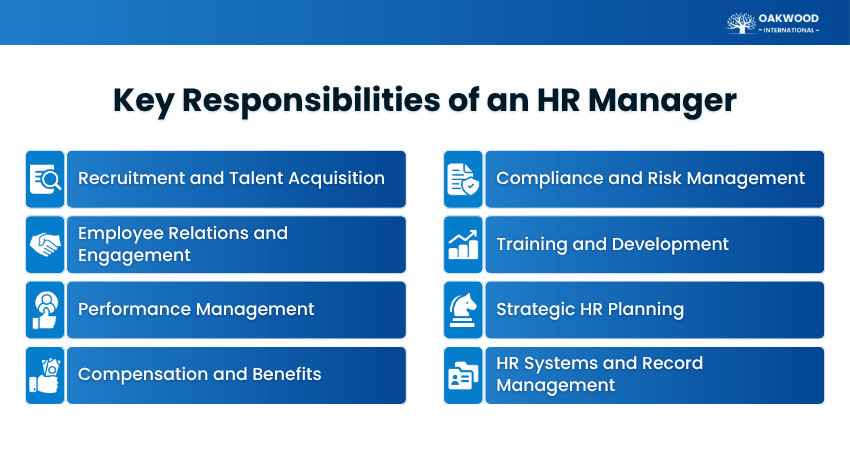
1) Recruitment and Talent Acquisition: Oversee the end-to-end hiring process, including workforce planning, sourcing, interviewing, and onboarding to attract suitable talent.
2) Employee Relations and Engagement: Manage workplace issues, resolve conflicts, and foster a positive culture that enhances employee engagement.
3) Performance Management: Develop appraisal systems, set performance goals, provide feedback, and support improvement plans to boost productivity.
4) Compensation and Benefits: Administer payroll, salary structures, incentives, and employee benefits to ensure fairness and competitiveness.
5) Compliance and Risk Management: Ensure adherence to labour laws, safety standards, and company policies to minimise legal and operational risks.
6) Training and Development: Identify learning needs and coordinate training programmes to support employee growth and career progression.
7) Strategic HR Planning: Contribute to long-term organisational goals by developing HR strategies that improve workforce effectiveness.
8) HR Systems and Record Management: Maintain accurate employee records using HR systems and leverage data for reporting and informed decision-making.
Strengthen HR strategy skills to align people initiatives with business objectives with the
HR Strategy Training
– Register now!
Key Differences Between HR Business Partner and HR Manager
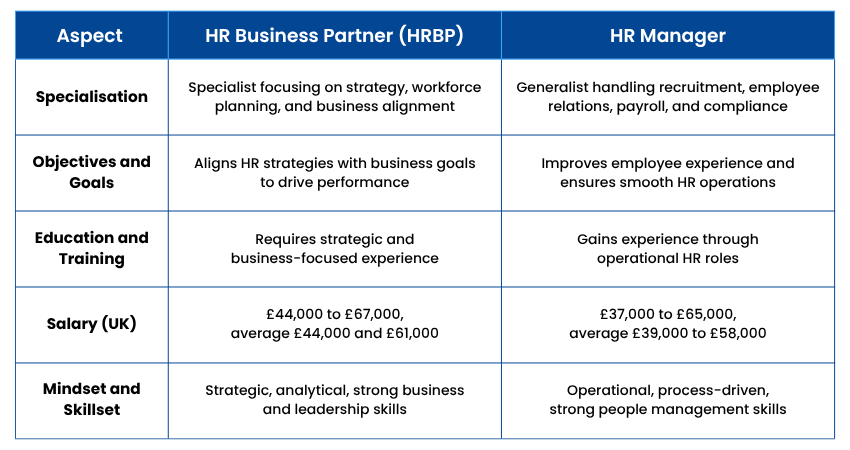
HR Business Partners and HR Managers differ in focus and responsibilities. In the HR Business Partner vs HR Manager comparison, HRBPs take a strategic approach, while HR Managers handle daily HR operations. These differences can be understood across the following areas:
1) Specialisation
HR Managers are generalists who handle key HR functions such as recruitment, employee relations, payroll, and compliance. Their role involves managing multiple responsibilities to ensure smooth operations and consistent HR processes across the organiation.
HR Business Partners are specialists who focus on strategic areas such as workforce planning and organisational development. They work closely with leadership to align people strategies with business objectives and support long-term organisational growth.
2) Objectives and Goals
HR Managers aim to support employees and maintain strong workplace relationships. They focus on improving satisfaction, retention, and productivity while ensuring HR processes run efficiently and consistently across the organisation.
HR Business Partners focus on achieving business outcomes by aligning HR initiatives with organisational goals. They collaborate with senior leaders to drive performance, support change, and ensure people strategies contribute to long-term business success.
3) Education and Training
Both HR Managers and HR Business Partners typically hold degrees in Human Resources or related fields. HR Managers often build their careers through operational roles, gaining practical experience in daily HR functions and employee management.
HR Business Partners typically require additional experience in strategic or business-focused roles. This helps them develop a deeper understanding of organisational goals, leadership dynamics, and business operations, enabling them to provide more effective and informed HR guidance.
4) Salary Comparison
HR Business Partners typically earn higher salaries due to their strategic responsibilities. In the UK, HRBP salaries range from £44,000 to £67,000, with averages between £44,000 and £61,000 depending on experience and location.
HR Managers also earn competitive salaries, though slightly lower. In the UK, salaries range from £37,000 to £65,000, with averages between £39,000 and £58,000 based on experience, industry, and location.
5) Mindset and Skillset
HR Managers require strong organisational, communication, and problem-solving skills to manage daily HR activities effectively. Their mindset is operational, focusing on efficiency, compliance, and maintaining a stable work environment.
HR Business Partners need strategic thinking, business acumen, and analytical skills to influence decisions. Their mindset is proactive and future-focused, helping them support leadership and drive long-term business growth.
Develop practical HR leadership skills for real-world organisational impact with our
Certified HR Manager Training
– Join today!
HRBP vs HR Manager: Competencies and Stakeholder Comparison
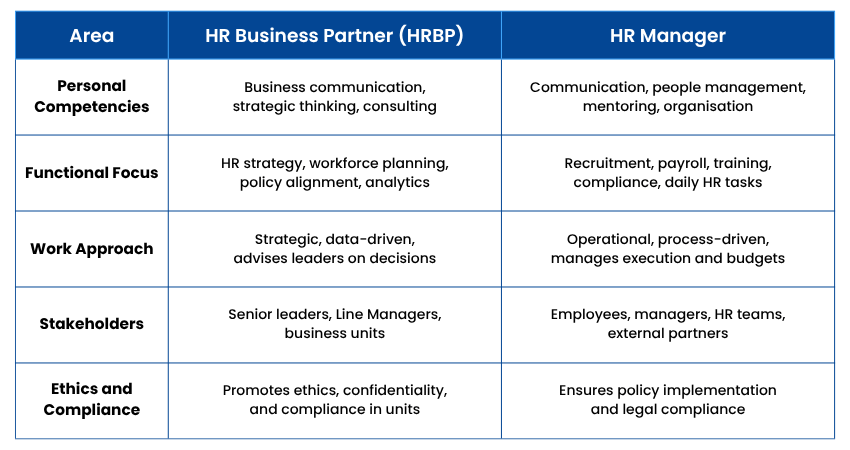
HR Manager vs HR Business Partner: Competencies and Stakeholder Comparison highlight how these roles differ in skills and stakeholder interactions. In the HR Business Partner vs HR Manager comparison, HRBPs focus on strategic thinking and leadership collaboration, while HR Managers emphasise operational efficiency and employee support. These differences are outlined below:
HRBP vs HR Manager: Which Role is Right for You?
Choosing between an HR Manager and an HR Business Partner (HRBP) depends on your interests and career direction. HR Managers focus on operational tasks like payroll, compliance, and employee support, making this role ideal for structured, people-focused work.
In contrast, HRBPs take on a strategic role by working closely with leadership to align people strategies with business goals. This job role is ideal for professionals who enjoy influencing decisions, driving organisational growth, and contributing to long-term business success.
Conclusion
HR Business Partner vs HR Manager highlights the contrast between strategy and execution in HR. HRBPs drive business growth through people strategies, while HR Managers ensure smooth daily operations. Understanding these roles helps you choose the right career path and build a strong, high-performing HR function.
Build leadership, communication, and HR strategy skills for career advancement with the HR Leadership Courses – Join today!
Frequently Ask Questions
Can an HR Manager Become an HR Business Partner?
Yes, an HR Manager can become an HR Business Partner by shifting from operational tasks to a strategic role. This requires building business acumen, using people analytics, and strengthening stakeholder management skills to align HR practices with organisational goals.
What Tools are Commonly Used by HR Managers and HRBPs?
HR Managers and HRBPs use tools like Human Resource Information Systems (HRIS), payroll systems, recruitment platforms, and performance software. HRBPs use analytics tools for insights, while HR Managers focus on tools that support daily HR operations and processes.
Which Role Has More Decision-making Authority: HRBP or HR Manager?
HR Business Partners (HRBPs) hold higher strategic decision-making authority, advising leaders to align people strategies with business goals. HR Managers have tactical authority, focusing on daily operations, compliance, and policy implementation to ensure smooth and efficient HR processes.
Related Blogs
Didn’t Find What You’re Looking For?

Our commitment to excellence ensures an exceptional learning experience tailored to your professional development needs.


© Copyright 2026 - Oakwood International ™ - All rights reserved.


SUPER SALE
 Get Amazing Discounts
And Deals
Get Amazing Discounts
And Deals