

 Back
Back


 Back to Catagories


Table of Contents


 + 44 7452
122728
+ 44 7452
122728
 22-Jul-2026
Maria Thompson
Imagine working in a company where you’re part of two teams at once, one for your department and one for a big project. That’s how a Matrix Organisational Structure works. It blends different leadership styles so employees can learn more, contribute better, and keep things moving across departments. This structure helps businesses stay flexible and efficient.
As projects become more complex, understanding the matrix setup becomes essential for growth, communication, and smart resource use. In this blog, we will discuss what a Matrix Organisational Structure is, how it works, and its types, benefits, and challenges. Let's dive in!
What is Matrix Organisational Structure?
A Matrix Organisational Structure is a type of company setup where employees report to more than one Manager. Usually, this means they work under both a Functional Manager (based on department) and a Project or Product Manager. It helps people use resources and skills more effectively across teams.
For example, in a tech company, a Software Developer may report to the Engineering Manager while also working with the Product Manager on a new app feature. This way, the developer supports the product’s progress while also staying updated with the engineering team’s goals. Matrix Structure helps manage complex projects, but can sometimes lead to confusion if roles are not clearly defined.

How Does a Matrix Organisational Structure Work?
Here are the ways a Matrix Organisational Structure works in a company:
1) Dual Authority Structure
Employees have two bosses, including a Functional Manager and a Project Manager. The Functional Manager oversees department duties, while the Project Manager handles project work. This creates a shared control system for better coordination.
1) Employees report to two managers
2) One focuses on the job role, one on the project
3) Clear planning is needed to avoid confusion
2) Cross-functional Team Formation
Teams are made up of people from different departments. These teams are created for specific projects or goals. Members keep their regular roles while contributing to the project.
1) Teams mix skills from various departments
2) Staff stay in their departments but join projects
3) Helps combine different knowledge and experience
3) Shared Decision-making
Both managers are involved in decision-making. The Functional Manager makes choices about resources and training. The Project Manager makes decisions about timelines and project direction.
1) Managers must agree on resource use
2) Decisions balance project and department needs
3) Requires regular communication between leaders
4) Balanced Workload Management
Employees must divide their time between daily work and project work. This needs clear schedules and good time management. Managers help avoid overload by adjusting tasks as needed.
1) Daily tasks and project duties run together
2) Time is split between different priorities
3) Managers coordinate to balance the workload
5) Integrated Communication Channels
A matrix structure requires open and regular communication. Teams and managers must keep each other updated. Meetings, reports, and tools are used to stay aligned.
1) Regular updates help track progress
2) Both Managers need to stay informed
3) Tools like dashboards support visibility
Transform workplace learning culture with our
CIPD Qualification
- Join today!
Types of Matrix Organisational Structures
Some of the Matrix Organisational Structure types that businesses use to manage people and projects include:
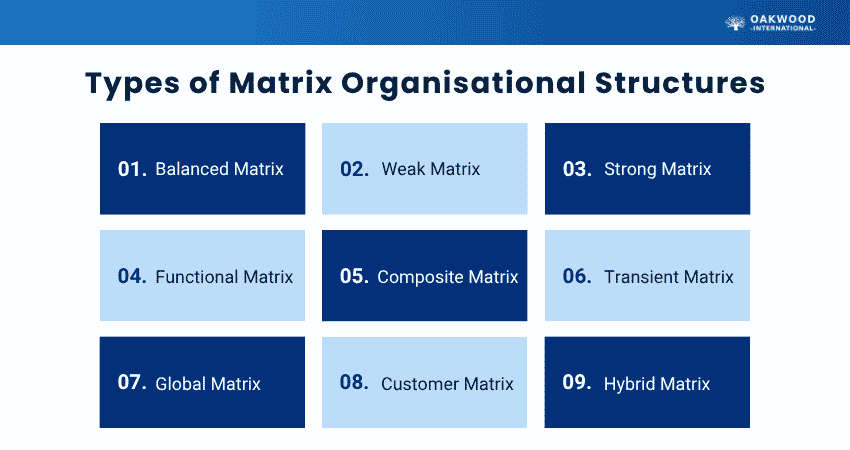
1) Balanced Matrix
In a Balanced Matrix, power is shared equally between the Project Manager and the Functional Manager. Employees report to both, but neither has more control. This type promotes teamwork and balanced decision-making.
1) Project manager and department head share decisions
2) Employees split time between projects and departments
3) Both managers guide planning and execution
2) Weak Matrix
In a Weak Matrix, the Functional Manager has more control than the Project Manager. The Project Manager plays a coordinating role but doesn’t have full authority. It's similar to a traditional structure with slight project support.
1) Functional Managers make most of the decisions
2) The Project Manager acts more as a coordinator
3) Employees mostly follow functional direction
3) Strong Matrix
A Strong Matrix gives more authority to the Project Manager. The Project Manager controls budgets, tasks, and team direction. It’s best for project-heavy organisations.
1) The Project Manager has more power than the functional heads
2) Clear focus on project goals and timelines
3) Team members report mainly to the Project Manager
4) Functional Matrix
In a Functional Matrix, projects are managed within departments. The Functional Manager controls the team while the Project Manager oversees the tasks. This is ideal when projects are related to a specific function.
1) Marketing team runs a campaign within its department
2) Engineers develop tools within the engineering unit
3) Finance leads budget analysis projects internally
5) Composite Matrix
A Composite Matrix combines different matrix types to suit business needs. It allows flexibility by blending strong, weak, or balanced approaches. Large companies often use this structure to manage complex teams with the help of the Divisional Structure .
1) Marketing uses a balanced matrix; tech uses a strong matrix
2) Different regions apply different structures
3) Flexibility based on project and team needs
6) Transient Matrix
This matrix is set up temporarily for a short-term project. It dissolves after the work is completed. It’s useful for unique projects that don’t need an ongoing structure.
1) Teams form for special product launches
2) Short-term project collaboration across departments
3) Team disbands after the project is done
7) Global Matrix
Used by international companies, a Global Matrix balances responsibilities across countries and functions. It helps manage global teams and markets while keeping strategies aligned.
1) Employees report to global and local leaders
2) Projects span multiple countries
3) Marketing run by the local team and the global brand team
8) Customer Matrix
This matrix focuses on customer types or segments. Teams are organised to meet specific customer needs, often across functions. It improves personalisation and service.
1) One team for enterprise clients, another for retail customers
2) Sales, support, and marketing tailored to customer type
3) Better understanding of unique client needs
9) Hybrid Matrix
The Hybrid Matrix blends matrix, functional, and project-based models. It offers the most flexibility by mixing approaches based on the business setup. Companies adapt this as they grow or change.
1) R&D uses a project matrix; operations use functional
2) Multiple reporting lines tailored to job roles
3) Combines the best features of other matrix types
Transform Your HR Career with CIPD Level 7 Advanced Diploma in Strategic People Management Course – Join now!
Advantages of the Matrix Organisational Structure
Here are some of the advantages of using a Matrix Organisational Structure:
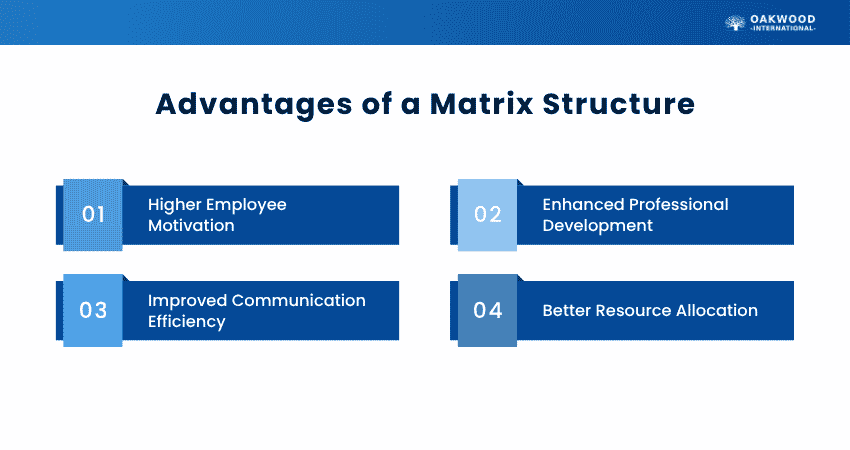
1) Higher Employee Motivation
A Matrix Structure increases employee engagement by allowing individuals to work on diverse projects while remaining connected to their functional teams. This variety keeps work interesting, builds a sense of ownership, and helps employees feel more valued for their skills and contributions.
2) Enhanced Professional Development
Employees benefit from exposure to multiple managers, projects, and disciplines. This broad experience strengthens their technical knowledge and soft skills, improves adaptability, and supports long-term career growth by offering continuous learning opportunities.
3) Improved Communication Efficiency
The Matrix Structure encourages regular interaction with different departments and project teams. This open flow of information reduces silos, improves coordination, and ensures that decisions are better informed and aligned with organisational goals.
4) Better Resource Allocation
Resources can be shared across projects based on priority and expertise. This flexibility helps organisations use talent more efficiently, avoid duplication of effort, and respond quickly to changing business or project demands. As a result, overall productivity and project outcomes often improve.
Inspire continuous growth journeys through the CIPD Level 5 Associate Diploma in People Management Course - Join today!
Disadvantages of the Matrix Organisational Structure
Here are some common challenges businesses may face in a Matrix Organisational Structure:
1) Power Struggles
With dual reporting concepts, conflicts can arise between Functional Managers and Project Managers over authority and priorities. These power struggles may delay decisions and create tension if responsibilities and decision rights are not clearly defined.
2) Role Confusion and Reduced Productivity
Employees may struggle to balance demands from multiple managers, leading to unclear responsibilities and workload stress. This confusion can reduce focus, slow task completion, and negatively affect overall productivity.
3) Competition Between Teams
Project teams may compete for limited resources, skilled employees, or management attention. Such competition can weaken collaboration, encourage siloed behaviour, and shift focus away from organisational goals.
4) Higher Managerial Costs
A Matrix Structure often requires additional managers, coordination meetings, and administrative oversight. These factors increase operational costs and management complexity, which may outweigh the benefits for smaller organisations.
How to Manage a Matrix Organisation?
Managing a Matrix Organisation requires a balanced approach that supports collaboration while maintaining clarity and control. Here is how you can do it:
1) Clearly Define Roles and Responsibilities
Clear role definitions help employees understand who they report to, what is expected of them, and how decisions are made. Similarly, well-documented responsibilities reduce confusion, prevent overlaps, and support accountability across both functional and project lines.
2) Promote Open and Clear Communication
Regular communication between managers and teams is essential in a Matrix Structure. Open talks ensure priorities are aligned, issues are addressed early, and employees receive consistent guidance from both reporting lines.
3) Implement Clear Conflict Resolution Mechanisms
Conflicts are common in Matrix Organisations due to shared authority. Setting formal conflict resolution processes, such as escalation paths or joint decision forums, helps resolve issues quickly and fairly without disrupting project progress.
4) Manage Workloads to Avoid Employee Burnout
In a Matrix Structure, employees frequently manage several responsibilities at the same time. Regularly tracking workloads and setting achievable expectations reduces stress, sustains productivity, and promotes overall employee well-being.
5) Review and Refine Your Management Strategy
A Matrix Organisation should be reviewed regularly to ensure it remains effective. Continuous evaluation allows leaders to identify gaps, refine processes, and adapt management approaches as organisational needs evolve.
Matrix Organisation Examples
Many organisations use a matrix structure to combine functional expertise with project-based collaboration. The following examples demonstrate how leading companies use matrix organisations to improve flexibility, resource sharing, and decision-making.
1) Nike
Nike shows matrix-like organisational features through its use of geographic operating segments and Global Brand Divisions. This approach allows the company to maintain consistent global operations while adapting products, marketing strategies, and business activities to the needs of different regional markets.
2)Starbucks
Starbucks uses a geographic leadership structure supported by global functions to manage its international operations. This helps the company maintain brand consistency while allowing regional teams to adapt operations, products, and customer experiences to local market preferences.
3) NASA
NASA has long used a matrix structure to manage complex projects requiring expertise from multiple disciplines. Scientists and engineers belong to functional departments but also work within mission-specific project teams, enabling effective collaboration and resource sharing across large-scale space programmes.
Conclusion
We hope this blog helped you understand the Matrix Organisational Structure and how it works in different business setups. This structure can improve teamwork, skill-sharing, and project success when used well. Though it has some challenges, like role confusion or extra costs, many companies use it to manage complex tasks. By choosing the right type and managing it clearly, businesses can benefit from both flexibility and control.
Transform workplace learning culture through the CIPD Level 3 Certificate in People Practice - Join today!
Frequently Ask Questions
What is a Matrix Organisational Structure in CIPD?
According to CIPD, a Matrix Organisational Structure is a management approach where employees report to more than one manager, usually a Functional Manager and a Project Manager. It helps improve flexibility, collaboration, and efficient use of skills across the organisation.
Is Coca-Cola a Matrix Organisational Structure?
Yes, Coca-Cola uses a Matrix Organisational Structure by combining geographic regions, functional expertise, and product divisions. This approach allows the company to manage global operations effectively while adapting to local markets and strategic priorities.
What is a Matrix Organisational Structure in the UK?
In the UK as well as globally, a Matrix Organisational Structure refers to a system where employees report to both Functional and Project Managers. It is commonly used in large organisations to improve collaboration, resource sharing, and responsiveness to complex business demands.
Related Blogs
Didn’t Find What You’re Looking For?

Our commitment to excellence ensures an exceptional learning experience tailored to your professional development needs.


© Copyright 2026 - Oakwood International ™ - All rights reserved.


SUPER SALE
 Get Amazing Discounts
And Deals
Get Amazing Discounts
And Deals