

 Back
Back


 Back to Catagories


Table of Contents


 + 44 7452
122728
+ 44 7452
122728
 08-Sep-2026
Maria Thompson
Every organisation collects people data, but not every organisation understands it. Numbers without meaning lead to poor decisions and missed opportunities. HR KPIs bring clarity by turning workforce data into insights that guide smarter hiring, stronger engagement, and better performance.
In this blog, you will learn what HR KPIs are, how HR teams use them, and which key metrics genuinely influence business outcomes. These are the KPIs that help HR move from reporting data to driving impact. So, let’s begin!
What are HR KPIs?
Human Resources Key Performance Indicators (HR KPIs) are measurable metrics used to evaluate how effectively HR strategies and activities support overall business objectives. They help organisations track key areas such as hiring, retention, productivity, engagement, and workforce costs, ensuring HR efforts deliver real, measurable value.
By using KPI for HR, HR teams can move beyond assumptions and make informed, data-led decisions. These indicators highlight trends, reveal problem areas, support future planning, and help align People Management with organisational priorities, making HR a more strategic and results-driven function.

How Does HR Use KPIs to Support Organisational Needs?
Human Resources Key Performance Indicators (HR KPIs) provide clear insights for better decision-making, performance tracking, and talent planning. Below are the key ways HR uses KPIs to support organisational needs:
1) Aligning HR Efforts with Business Goals: HR KPIs help ensure that HR initiatives such as recruitment, training, and development directly support wider organisational objectives.
2) Enabling Data-driven Decisions: Reviewing KPI progress through tools like HR dashboards allows HR teams to make informed choices around policies, budgets, and workforce strategies.
3) Measuring Workforce Performance: Metrics such as employee productivity and goal achievement show how effectively teams are meeting business expectations.
4) Monitoring Engagement and Retention: Indicators like engagement scores and turnover rates highlight employee morale and satisfaction, which affect performance and retention.
5) Supporting Workforce Planning:
HR uses KPI data to predict future staffing requirements, identify skill gaps, and ensure the organisation has the right talent in the right roles at the right time.
Top 15 KPIs for Human Resources
Here are the 15 most important HR KPIs, each focusing on a distinct area of workforce performance. Let’s explore them in detail.
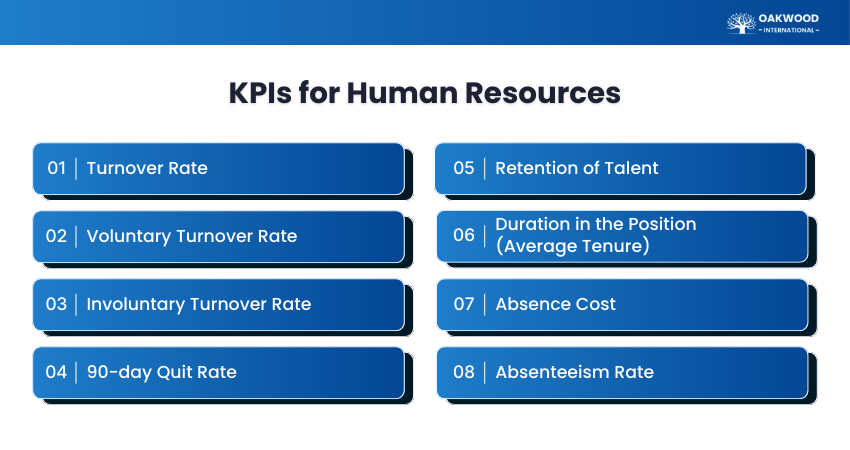
1) Turnover Rate
The turnover rate measures the percentage of the workforce that leaves an organisation during a specific period. It helps HR teams assess workforce stability and understand whether people are staying long enough to support productivity, morale, and consistent business performance.
The turnover rate is calculated as: (Number of Leavers ÷ Average Number of Employees) × 100. A high rate may signal issues with pay, culture, or leadership and can increase hiring costs, making regular tracking essential for retention planning.
2) Voluntary Turnover Rate
Voluntary turnover rate measures the percentage of employees who leave an organisation by choice. It focuses on employee-led departures and provides insight into satisfaction, engagement, and how employees perceive their roles and work environment.
This KPI can be calculated as a percentage of total separations or against the total workforce. A high voluntary turnover rate usually signals issues such as limited growth opportunities, weak leadership, or unmet expectations, making it a key metric for improving retention strategies.
3) Involuntary Turnover Rate
Involuntary turnover rate measures the percentage of employees who leave an organisation due to employer-led decisions. This includes departures caused by layoffs, terminations, or redundancies rather than employee choice.
This KPI can be calculated as a percentage of total employee exits or in relation to the total workforce during a specific period. Tracking involuntary turnover helps HR assess workforce planning, hiring quality, and the impact of organisational changes.
4) 90-day Quit Rate
The 90-day quit rate measures how many new employees leave the organisation within their first three months. It focuses on early exits, which often reflect issues with hiring decisions, onboarding processes, or role expectations.
A high 90-day quit rate can negatively affect productivity, team morale, and recruitment costs. Tracking this KPI helps HR evaluate hiring quality and improve onboarding to ensure the right people are placed in the right roles.
5) Retention of Talent
Retention of talent measures the percentage of employees who remain with an organisation over a specific period. Unlike turnover, which focuses on who leaves, this KPI highlights how well a company keeps its people, especially skilled and high-performing employees.
The Employee Retention Rate is calculated as (Remaining Headcount at End of Period ÷ Headcount at Start of Period) × 100. High retention strengthens workforce stability, reduces hiring costs, and reflects how pay, benefits, policies, and workplace culture influence employee loyalty.
Learn strategic planning skills that make a measurable difference at work through the
HR Strategy Training
– Register now!
6) Duration in the Position (Average Tenure)
Duration in the position, also known as average tenure, measures how long employees typically remain in the same role. It helps HR understand career movement within the organisation and whether employees are progressing or staying static for extended periods.
Average tenure is calculated as (Total months in role ÷ Total employees). Long periods without growth can prompt employees to leave. Tracking this KPI helps HR identify development gaps and improve learning, progression, and engagement strategies.
7) Absence Cost
Absence cost measures the total financial impact of employee absence on an organisation. It includes employee wages during absence, the cost of managing absence, and any expenses related to temporary cover or lost productivity.
This KPI is especially important in regions with strong employee protections, where paid leave policies increase costs. Tracking absence cost helps HR understand its financial impact and make better decisions around well-being, attendance management, and
workforce planning
.
8) Absenteeism Rate
Absenteeism rate measures the percentage of total working hours lost due to employee absences such as sick leave, lateness, or unexcused time off. It helps HR teams understand attendance patterns and how regularly employees are available to perform their roles.
The absenteeism rate is calculated as (Total Hours of Absence ÷ Total Work Hours Available) × 100. High absenteeism raises costs and lowers productivity, making this KPI useful for spotting patterns and introducing preventive steps like well-being training programmes or flexible work policies.
9) Time to Fill
Time to fill measures the average number of days required to fill a vacant role, starting from when the position is approved or announced to when a new employee is onboarded. It reflects how quickly an organisation can respond to staffing needs.
Time to fill is calculated as (Total days taken to fill roles ÷ Number of roles filled). Longer hiring timelines can increase costs and workload pressure on teams, while a shorter time to fill indicates an efficient recruitment process with minimal operational disruption.
10) Cost Per Hire
Cost per hire measures the average expense involved in recruiting and onboarding a new employee. It includes costs such as job advertising, recruiter fees, interview time, and initial training, giving HR a clear view of hiring investment.
This KPI is calculated as (Total Recruitment and Onboarding Costs ÷ Number of Hires). Tracking cost per hire helps HR manage recruitment budgets, identify inefficiencies, and forecast future hiring expenses while evaluating the return on recruitment strategies.
Gain essential HR skills designed for non-HR Managers to lead teams with confidence with
HR Skills for Non-HR Managers Training
– Join now!
11) Quality of Hire
Quality of hire measures the value a new employee brings to an organisation and how well they contribute to long-term success. It reflects factors such as performance, cultural fit, engagement, and retention after joining.
This KPI also shows how effective HR is at recruiting and selecting the right candidates. Consistently achieving a high quality of hire helps organisations build strong teams, improve performance, and reach strategic goals more efficiently.
12) Training Return on Investment (ROI)
Training Return on Investment (ROI) measures the financial value an organisation gains from its training and development programmes. It compares the benefits of training, such as improved productivity or performance, against the total cost of delivering the training.
Training ROI is calculated by subtracting the training costs from the benefits gained, then dividing the result by the total training cost. This KPI helps HR evaluate whether learning initiatives are delivering real value and supporting business performance.
13) Employee Productivity Rate
Employee productivity rate measures how efficiently employees complete tasks and achieve goals within their roles. It shows how effectively the workforce uses time, skills, and resources to deliver results that support organisational performance.
Employee productivity is calculated as Productivity = (Output Produced ÷ Input of Work Hours). Tracking this KPI helps HR optimise workloads, refine workplace policies, and improve performance by considering both the quantity and quality of work delivered.
14) Employee Engagement Index
The Employee engagement index measures how motivated, committed, and involved employees feel in their work and the organisation. It is typically assessed using surveys and feedback tools similar to those used for employee satisfaction , excluding exit interviews.
A high engagement index is linked to stronger productivity, better customer service, and lower turnover. Tracking this KPI helps HR understand employee morale and take action to build a more motivated, high-performing workforce.
15) Employee Well-being Index
The Employee well-being index is a composite metric that measures how employees feel about their overall health and work experience. It typically combines survey data on mental and physical health, work-life balance, stress levels, and sense of purpose.
Tracking this KPI helps organisations understand how well they are supporting employee well-being . A strong well-being index is closely linked to higher productivity, lower absenteeism, and improved retention, making it a key indicator of long-term workforce sustainability.
Learn the fundamentals of HR and prepare for a career that makes a real impact in any workplace through the
HR Course
– Join now!
Characteristics of Strong HR KPIs
Strong HR KPIs provide clarity and real business value by guiding decisions and tracking meaningful progress. Here are the key characteristics that make HR KPIs effective and useful:
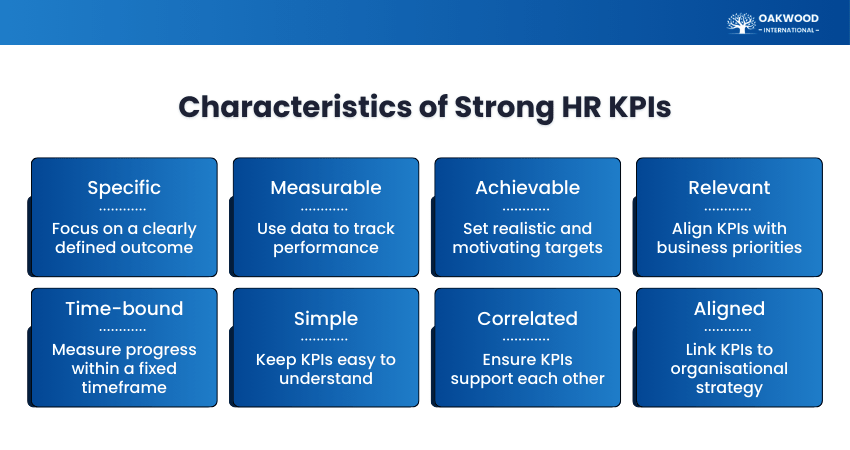
1) Specific: Each KPI should focus on a clear and well-defined outcome, such as reducing employee turnover or improving engagement levels.
2) Measurable: HR KPIs must be supported by accurate, quantifiable data so progress can be tracked consistently over time.
3) Achievable: Targets should be ambitious yet realistic, encouraging improvement without overwhelming teams.
4) Relevant: Strong KPI for HR are closely linked to business priorities, ensuring HR efforts support organisational success.
5) Time-bound: HR KPIs should be measured within a set timeframe, such as monthly or quarterly, to monitor progress and drive accountability.
6) Simple: KPIs should be easy to understand so employees clearly know what they are working towards.
7) Correlated: HR KPIs should complement each other and avoid conflicting objectives that create confusion or inefficiency.
8) Aligned:
Each KPI should directly support the company’s strategy and reflect how HR contributes to overall goals.
Conclusion
Tracking the right HR KPIs helps organisations turn people data into informed action. Clear metrics support better decisions, stronger engagement, and effective talent planning. When used consistently, these indicators help HR teams demonstrate value, improve workforce outcomes, and build a more resilient, productive, and people-focused organisation.
Unlock your leadership potential through HR Leadership Courses designed to support confident and effective decision making - Join now!
Frequently Ask Questions
What are the Seven Major HR Activities?
The seven major HR activities include:
1) Recruitment and Selection
2) Performance Management
3) Learning and Development
4) Compensation and Benefits
5) Employee Relations and Engagement
6) Compliance and Risk Management
7) HR Systems and Analytics
What are the 4 P's of KPI?
The 4 P’s of KPI refer to Purpose, Performance, Process, and People. These elements help ensure KPIs are meaningful, aligned with organisational goals, easy to act on, and clearly owned by the right individuals or teams.
What is a KPI Checklist?
A KPI checklist is a tool used to ensure KPIs are relevant, clearly defined, measurable, aligned with business objectives, and reviewed regularly. It helps organisations track the right metrics and avoid unnecessary data collection.
Related Blogs
Didn’t Find What You’re Looking For?

Our commitment to excellence ensures an exceptional learning experience tailored to your professional development needs.


© Copyright 2026 - Oakwood International ™ - All rights reserved.


SUPER SALE
 Get Amazing Discounts
And Deals
Get Amazing Discounts
And Deals