

 Back
Back


 Back to Catagories


Table of Contents


 + 44 7452
122728
+ 44 7452
122728
 11-Aug-2026
Maria Thompson
Every thriving company starts as a small idea powered by people willing to learn and adapt. As industries evolve, customer expectations change, and new technologies emerge, businesses can no longer rely completely on past knowledge or experience. Continuous learning has become essential for staying competitive, adapting to change, and driving long-term success.
Employee Training is more than a one-time onboarding activity. It is an ongoing investment that equips employees with the knowledge and skills to perform at their best. Regular learning helps employees adapt to change and build confidence in their roles. This blog explores 15 key Benefits of Training Employees and why investing in employee development creates lasting value for both employees and organisations. Let's dive in!
What is Employee Training?
Employee Training is the structured process of enhancing employees' knowledge, skills, behaviours, and competencies required to perform their job effectively. It can include technical skills, soft skills, health and safety awareness, leadership development, or even company policies and procedures.
Modern Employee Training can take many forms, including classroom sessions, workshops, e-learning modules, mentoring, coaching, simulations, and on-the-job learning. The main purpose is to improve employee performance, reduce mistakes, and help employees contribute more effectively to organisational goals.

15 Benefits of Training Employees
Employee Training does more than prepare employees to perform their jobs. It helps businesses improve performance, build confidence among staff, and create a more organised way of working. Let's check the Benefits of Training Employees to see how regular training supports both employee development and overall business success:
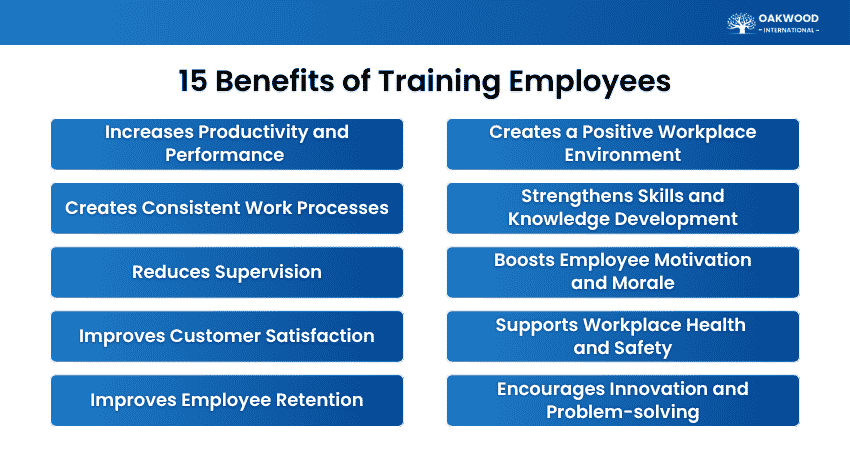
1) Increase Productivity and Performance
Training helps employees understand their tasks clearly and perform them correctly. When employees know the right methods and procedures, they complete work faster and make fewer mistakes. This directly improves work efficiency and output. As performance improves across teams, the overall productivity of the organisation increases significantly.
2) Creates Consistent Work Processes
Consistency is important in any organisation, especially those that depend on customer satisfaction and standardised outputs. Without training, employees may complete the same task in different ways, leading to inconsistent results. Regular Employee Training ensures everyone follows the same procedures and quality standards.
3) Reduces Supervision
Managers often spend large portions of their time correcting mistakes and answering repetitive questions. This usually happens when employees are unsure about their responsibilities. However, when employees are properly trained, they require less constant monitoring. They understand their work and complete tasks independently without repeated instructions.
4) Improves Customer Satisfaction
Training helps employees interact with customers in a professional and confident manner. They learn how to communicate clearly, listen carefully to customer needs, and respond appropriately to questions or complaints with strong product knowledge. This reduces misunderstandings, which increases customer trust in the brand and encourages repeat business.
5) Improves Employee Retention
Employees are more likely to stay in organisations that invest in their growth. Training shows that the
Company Values
its development and future. When employees see opportunities to learn and advance, they feel motivated to remain with the organisation. This becomes one of the Benefits of Training Employees as it reduces recruitment costs and preserves experienced talent.
6) Creates a Positive Workplace Environment
Training helps employees understand their roles and how their work connects with others. When they know what is expected, confusion decreases and daily tasks run more smoothly. As a result, the workplace becomes more organised, cooperative, and positive, creating an environment where people feel comfortable, valued, and motivated to contribute.
7) Strengthens Skills and Knowledge Development
Training helps employees stay updated with the tools, systems, and technologies used in their roles. They learn how to operate software, equipment, and work processes correctly, which improves accuracy and reduces avoidable errors. As their technical competence grows, employees confidently handle tasks and adapt to new technologies.
Strengthen your organisation's workforce strategy with
Talent Management Training
– Register today!
8) Boosts Employee Motivation and Morale
Training makes employees feel capable. When they understand how to perform their tasks properly, their daily work becomes less stressful. This sense of competence improves
Job Satisfaction
and encourages a more positive attitude toward work. This leads to higher team morale and stronger team participation.
9) Supports Workplace Health and Safety
Training Employees doesn't always focus on technical skills or personal development. It also provides guidance on workplace health and safety to improve
Employee Well-Being
. They learn to identify potential risks, handle materials carefully, and respond properly in emergencies. This awareness helps prevent accidents and injuries during daily operations.
10) Encourages Innovation and Problem-solving
Employee Training helps professionals develop creative thinking and effective problem-solving abilities by exposing them to new ideas, industry trends, emerging technologies, and best practices. When employees feel confident in their skills and supported by the organisation, they are more likely to suggest innovative solutions that improve processes, productivity, and business competitiveness.
11) Cost Reduction and Higher Profitability
At first glance, training may appear expensive. However, lack of training is far more costly. Mistakes, product defects, customer complaints, safety incidents, and employee turnover all create hidden expenses. Training reduces these losses and supports improved efficiency, fewer errors, and better service to increase profitability in the long term.
12) Enhances Knowledge of Company Policies and Goals
Training helps employees understand organisational values, policies, and long-term objectives. They become aware of compliance requirements, ethical standards, and performance expectations. This alignment reduces policy violations, improves accountability, and ensures that everyone works toward shared goals.
13) Better Communication and Collaboration
Investing in Employee Training and development also strengthens teamwork and communication across the organisation. When employees build these skills, they're better positioned to collaborate effectively and work through team conflicts constructively, which reduces friction and boosts overall performance. Stronger communication also helps teams solve problems more efficiently and achieve shared organisational goals.
14) Supports Goal Achievement
Training ensures employees have the required skills and knowledge to meet individual, team, and organisational objectives. By improving competence and confidence, organisations can achieve targets while adapting successfully to changing business requirements. It also helps align employee performance with long-term business priorities.
15) Quality Improvement
Employee Training promotes best practices, attention to detail, and continuous improvement across business processes. When employees become more skilled and knowledgeable, they produce higher-quality work, minimise defects, maintain consistent standards, and deliver better products or services to customers. Consistent quality also strengthens customer trust and enhances the organisation's reputation.
Conclusion
Employee Training is one of the most effective ways to improve both individual performance and organisational success. The Benefits of Training Employees extend beyond skill development, as it also improves communication, teamwork, and confidence across the workforce. It boosts productivity, supports retention, enhances customer service, and helps organisations adapt to changing business needs, enabling sustainable long-term growth.
Develop the skills needed to lead productive and engaged teams with People Management Courses – Begin now!
Frequently Ask Questions
What is the Goal of Employee Training?
The goal of Employee Training is to prepare employees with the knowledge and skills needed to perform their roles effectively while aligning their performance with organisational objectives.
How to Develop an Employee Training Programme?
Developing an Employee Training Programme involves identifying skill gaps, defining learning objectives, selecting suitable training methods, creating structured content, and measuring outcomes. A well-planned programme helps improve employee performance, productivity, engagement, and long-term organisational growth.
What are the Positive Effects of Employee Training?
Training Employees increases business productivity, improves the quality of work, boosts employee confidence, enhances teamwork, and strengthens customer trust. It reduces managers’ need to closely monitor daily tasks and helps minimise errors.
Didn’t Find What You’re Looking For?

Our commitment to excellence ensures an exceptional learning experience tailored to your professional development needs.


© Copyright 2026 - Oakwood International ™ - All rights reserved.


SUPER SALE
 Get Amazing Discounts
And Deals
Get Amazing Discounts
And Deals