

 Back
Back


 Back to Catagories


Table of Contents


 + 44 7452
122728
+ 44 7452
122728
 08-Sep-2026
Maria Thompson
Businesses, like people, need to keep learning to stay ahead. Picture a company that doesn’t just react to change but thrives on it, constantly evolving, learning from mistakes, and sharing insights to drive innovation. That’s the power of Organisational Learning, a process that turns everyday experiences into opportunities for growth.
It goes beyond training sessions or formal courses. It is about creating a workplace culture where employees reflect on outcomes, learn from mistakes, and apply insights to future decisions. In this blog, you will learn about Organisational Learning, its principles, key traits, and more. So, keep reading to learn more about it!
What is Organisational Learning?
Organisational Learning is the process by which organisations continuously improve by gaining knowledge, reflecting on experience, and adapting their actions to achieve better performance. It focuses on how individuals and teams learn from success, mistakes, feedback, and data, and how that learning is shared across the organisation.
Instead of knowledge staying with just one person, Organisational Learning turns individual insights into shared understanding. Over time, this strengthens decisions, improves processes, and builds adaptability.
Learning-focused organisations encourage curiosity, open communication, and continuous improvement. Organisational learning is commonly grouped into four types of knowledge, explained below.
1) Individual Knowledge
Individual knowledge forms the foundation of Organisational Learning. It happens when an employee learns new skills or ideas and applies them to their work. This improves productivity and performance, and its impact grows when individuals share their knowledge.

2) Group Knowledge
Organisational Learning develops when employees learn together through collaboration and shared challenges. When one member encounters a problem and shares the solution, the whole team benefits, leading to better problem-solving and improved productivity.
3) Organisational Knowledge
It emerges when learning is integrated into systems, processes, and everyday practices. It includes how a company gathers information, stores it, and distributes it across departments. This helps companies run efficiently and be prepared for industry changes.
4) Inter-organisational Knowledge
It extends learning beyond one organisation to branches, franchises, or partner companies. This type of learning relies on trust, shared goals, and strong relationships, enabling collaboration and collective growth.
Why is Organisational Learning Important?
A strong learning culture brings numerous benefits that enhance business performance and employee satisfaction. The following are some of the points to explain why Organisational Learning is important:
1) Job Satisfaction
Employees feel more engaged and motivated when they are continuously learning and growing in their roles. Organisational Learning fosters a positive work environment that values development.
2) Lower Turnover
Companies that invest in employee growth tend to have higher retention rates. Employees are more likely to stay when they see opportunities for learning and career progression. This reduces recruitment costs and helps organisations retain valuable experienced employees.
3) Boost Efficiency
Organisational Learning helps employees work smarter, not harder. By refining processes and improving organisation skills, one can increase productivity and reduce wasted effort. Over time, this leads to faster decision-making and better use of resources across teams.
4) Grow Leaders
Leadership skill development is a key outcome of Organisational Learning. Companies that encourage leadership qualities cultivate future leaders who can drive business success. This ensures leadership continuity and prepares organisations for long-term growth.
5) Improve Adaptability
Businesses that continuously learn can navigate market changes and disruptions more effectively. A culture of learning enhances resilience and competitiveness. It enables organisations to embrace innovation and stay relevant in a dynamic business environment.
Key Traits of a Learning Organisation
Organisational Learning requires a shift in mindset, where learning is embedded into daily work. Let’s look at the key traits of a learning-focused organisation below.
1) A Shared Vision with Aligned Goals
It gives learning a clear purpose within the organisation. Employees understand how their roles, development, and learning efforts contribute to business success. This increases engagement and encourages employees to focus on learning.
2) A Commitment to Personal Growth
This ensures that learning begins with individuals. Learning organisations provide employees with opportunities to build new skills and expand their knowledge. This empowers employees to take ownership of their learning and apply it to their work.
3) Continuous Reflection and Open Communication
This creates an environment where learning thrives. Employees are supported to discuss challenges, questions about existing processes, and share errors. This helps organisations identify gaps, improve working ways, and turn experiences into learning moments.
4) Active Knowledge Sharing and Collaboration
This benefits everyone, not only employees. Learning organisations capture and share insights through mentoring, teamwork, and digital platforms. Spreading knowledge strengthens collective strength and supports continuous improvement.
5) Recognising and Addressing Systemic Barriers
It is essential for sustaining learning. Learning organisations take a systems-thinking approach to removing obstacles, such as rigid hierarchies or outdated processes, to support seamless knowledge flow.
Unlock leadership potential with our CIPD Level 5 Associate Diploma in People Management – Sign up now!
Three Levels of Organisational Learning
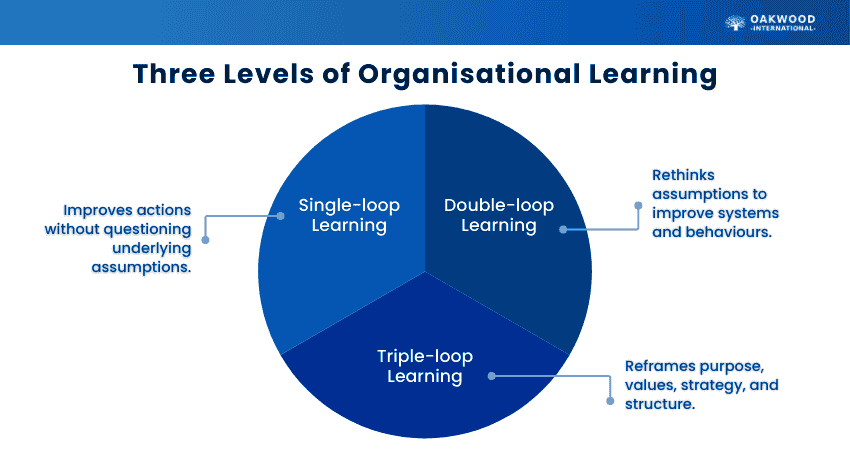
The depth of Organisational Learning depends on how organisations respond to problems and learn from experience. Let’s have a look at its three levels.
1) Single-loop Learning
Here, employees focus on improving existing processes to solve recurring issues. The emphasis is on action and efficiency instead of changing behaviour, values, or assumptions. Teams concentrate on how to fix a problem within the current system.
Example:
A customer support team receives complaints about long wait times for issue resolution. For managing the high volume of tickets, the manager decides to increase the number of support agents during peak hours.
1) Action: Increase staff during peak hours.
2) Result: Reduced wait times and customer complaints.
3) Assumptions: Focus remains on adding resources instead of reviewing call handling processes or training quality.
2) Double-loop Learning
Double-loop learning involves questioning existing assumptions, beliefs, and policies. It focuses on understanding why problems occur and encourages employees to challenge the status quo. This leads to deeper insights and meaningful behavioural change.
Example:
Using the same customer service example, the manager adopts a deeper approach instead of simply increasing staffing levels.
1) Action: Conduct team meetings to identify root causes of long waiting times.
2) Analysis: Identifying issues, such as limited training or outdated processes.
3) Assumptions: Recognising rigid scripts and limited agent empowerment.
4) Change in Policies: Introducing flexible call-handling processes and improving training procedures.
5) Result: Shorter wait times, improved satisfaction of customers, and a confident customer service team.
3) Triple-loop Learning
Triple-loop learning questions the organisational goals, strategies, and structures. Here, leadership reflects the organisation's purpose, values, and alignment with expectations. This involves collaboration across departments or external partners.
Example:
Let’s take the same customer support scenario. Here, the leadership approaches it with a detailed review of both customer service operations and the organisation’s broader mission.
1) Action: Reviewing customer service strategy alongside organisational values and purpose
2) Analysis: Collecting insights through surveys, workshops, and employee discussions
3) Key Findings: Outdated vision, misalignment with organisational values, and rigid hierarchies hindering innovation
Build strong HR foundations and kick-start your career with our CIPD Level 3 Certificate in People Practice – Join now!
Types of Organisational Learning
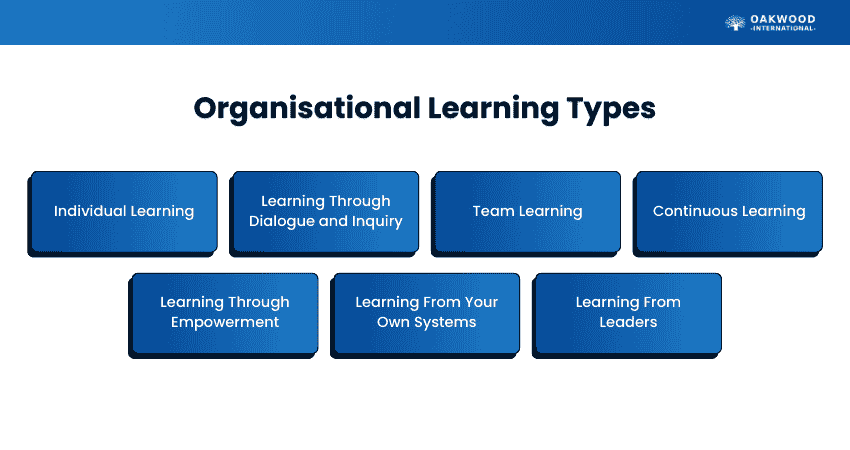
Below are the key types of Organisational Learning. Let’s look at them.
1) Individual Learning
It takes place when an employee develops skills and knowledge through experience, training, and self-development. This helps employees stay engaged while building capabilities to support better decision-making.
2) Learning Through Dialogue and Inquiry
It happens when employees learn from open communication, discussions, and questioning. Shaping perspectives and challenging ideas build common understanding and improve the decision-making process.
3) Team Learning
It develops as employees work together to solve problems. Collaborative learning improves communication, improves efficiency, and enables teams to combine ideas to create innovative solutions.
4) Continuous Learning
It ensures development is ongoing and regular. Here, learning opportunities, such as mentoring and workshops, support curiosity and help employees to improve how they approach their work.
5) Learning Through Empowerment
It occurs when employees are trusted with responsibility and decision-making authority. This helps them learn practically, build confidence in their domain, and build relevant industry skills.
6) Learning From Your Own Systems
It involves using insights from business tools, such as reporting, analytics, and HR systems. These systems provide valuable data that organisations can utilise to improve processes and improve decision-making.
7) Learning From Leaders
It plays a crucial role in shaping the learning culture. When leads model learning behaviours and share their experiences with the team, they encourage employees to value development and apply learning in their work.
How to Promote Organisational Learning?
The process of developing a learning culture depends on deliberate methods which support continuous development.

Step: 1 Grasp Impact
The central step to implement effective learning starts with comprehension about its worth. Business leaders must identify how Organisational Learning affects both growth and employee motivation and innovation in organisations.
Step: 2 Promote Sharing
The free movement of information should exist between different organisational teams. An environment focused on learning emerges when organisations support collaborative work together with mentorship programmes training along with open discussion opportunities.
Step: 3 Integrate Learning
Operation procedures should not exist apart from learning activities. The design of work activities including project tasks and collaboration sessions helps natural knowledge retention by employees.
Step: 4 Solve Systematically
Educating employees to address problems methodically establishes learning capabilities that endure for the long term. Organisations need to review difficulties before executing solutions while creating documentation for system utilisation in later stages.
Step: 5 Analyse Processes
Continuous process and strategic assessment enable organisations to detect both present gaps and future improvement chances. Organisations become better at making choices through the analysis of past operational results.
Lead people strategy at the highest organisational level with CIPD Level 7 Advanced Diploma in Strategic People Management – Join now!
Challenges in Organisational Learning
Organisational Learning is not always easy to embed in the organisation. Understanding these barriers is essential to help organisations build a sustainable learning culture. Let’s look at the challenges below.
1) Information Overload
It is a common challenge, as employees are constantly exposed to information. With excessive information to process, identifying the relevant learning can be overwhelming. For solving this, curated learning can help by providing personalised recommendations that match an employee’s goals, roles, and learning preferences.
2) Lack of Time
It often prevents employees from engaging in learning activities. With a busy schedule, tight deadlines, and performance targets to meet, development is pushed aside. Integrating learning into everyday work and using short learning formats enables employees to learn continuously without disrupting their routines.
3) Resistance to Change
It can slow down Organisational Learning initiatives. Some employees view learning as an added burden instead of a benefit. Clear communication about how learning supports personal as well as professional growth helps to build trust and encourage active participation.
4) Knowledge Silos
Knowledge silos occur when valuable insights remain confined within specific teams instead of being shared across the organisation. This limits the organisational growth and leads to repeated mistakes. Encouraging cross-department collaboration, mentoring, and shared digital platforms helps to spread knowledge. This ensures learning benefits the entire organisation instead of selective teams.
5) Measuring Impact
This is one of the most difficult challenges in Organisational Learning. While participation in training can be tracked, linking learning to business outcomes is complex. Using data from learning platforms and performance analytics helps organisations understand which learning initiatives create value and influence long-term performance.
Conclusion
Organisational Learning is about how organisations think, adapt, and grow over time. When learning becomes part of daily work, businesses are prepared to respond to change, solve problems, and innovate with confidence. It empowers individuals, encourages collaboration, and turns experiences into insights. When done properly, it drives resilience, performance, and sustained long-term success.
Start your journey in people leadership today and drive real business impact with CIPD Qualification Courses – Join today!
Frequently Ask Questions
What’s the Difference Between L&D and OD?
Learning and Development (L&D) focuses on improving skills and performance through training and development. Organisational Development works at a broader level. It improves culture, structure, and strategy to shape organisations systems to sustain long-term success.
What are the Seven Key Areas of Organisational Learning?
The seven key areas of learning include:
1) Leadership development
2) Individual learning
3) Team collaboration
4) Knowledge sharing
5) Systems thinking
6) Continuous improvement
7) Innovation and experimentation
What are the 7Cs of Learning?
The 7Cs of learning include:
1) Critical Thinking
2) Creativity
3) Collaboration
4) Communication
5) Computer Literacy
6) Cross-cultural Understanding
7) Career and Learning Self-reliance
Related Blogs
Didn’t Find What You’re Looking For?

Our commitment to excellence ensures an exceptional learning experience tailored to your professional development needs.


© Copyright 2026 - Oakwood International ™ - All rights reserved.


SUPER SALE
 Get Amazing Discounts
And Deals
Get Amazing Discounts
And Deals