

 Back
Back


 Back to Catagories


Table of Contents


 + 44 7452
122728
+ 44 7452
122728
 07-Sep-2026
Maria Thompson
Have you ever felt more motivated when your opinion was truly valued at work? When a leader asked for your ideas instead of simply giving instructions? Feeling heard and respected can transform how you think, work, and perform. This sense of inclusion lies at the heart of Democratic Leadership, where collaboration and shared decision-making take priority.
In this blog, you will learn what is Democratic Leadership means and why it matters in modern organisations. We will explore its characteristics, examples, and benefits, and show how it inspires teams and encourages collaborative decision-making. Let's get started!
What is Democratic Leadership?
Democratic Leadership is a leadership style where leaders actively involve employees and every group in decision-making. Instead of deciding alone, they encourage open discussions, welcome diverse opinions, and value input from every group within the organisation. Although leaders make the final decision, it is often shaped by collective ideas, creating a balanced and inclusive approach.
This style works well in organisations that value collaboration, transparency, and innovation. By empowering employees to share ideas and solve problems, Democratic Leadership builds trust, boosts engagement, and encourages creativity. As a result, teams become more motivated, confident, and effective.

Characteristics of Democratic Leadership
Democratic Leadership is defined by behaviours that promote participation, trust, and collaboration within teams. Below are the key characteristics that explain how Democratic Leaders engage employees and shape decision-making.
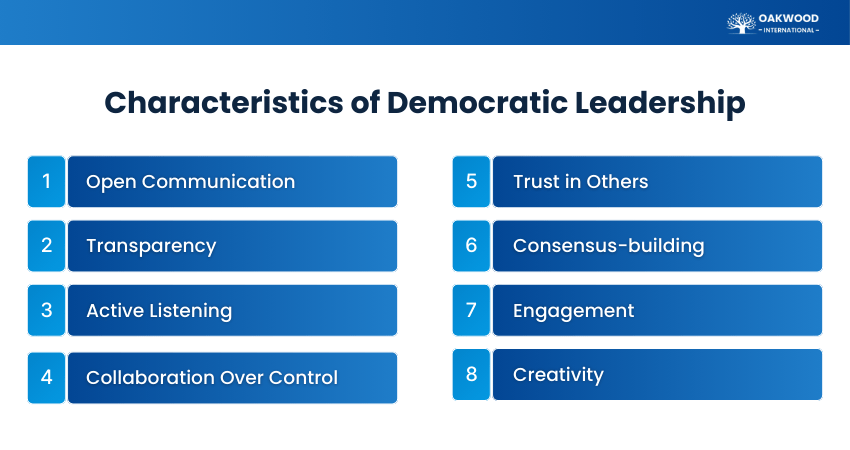
1) Open Communication
Open communication means Democratic Leaders encourage employees and each group to share ideas, ask questions, and express opinions freely. They create a supportive environment where people feel confident speaking up, strengthening trust and open dialogue across teams.
This open exchange of ideas improves understanding, reduces confusion, and encourages diverse perspectives. As a result, teams collaborate more effectively, identify issues early, and develop practical solutions that support organisational goals and continuous improvement.
2) Transparency
Transparency refers to being open and sincere about organisational goals, decisions, and challenges. Democratic Leaders share relevant information with their teams, helping employees understand priorities and feel connected to the organisation's direction and purpose.
By practising transparency, leaders build trust and accountability within teams. Employees gain clarity about expectations, feel more involved in decision-making, and align their efforts with organisational objectives, which strengthens performance and workplace confidence.
3) Active Listening
Active listening involves genuinely understanding employees' ideas, concerns, and feedback. Democratic Leaders pay attention to different viewpoints instead of reacting quickly or imposing opinions, which makes communication more meaningful and respectful within teams.
When leaders practise active listening, employees feel valued and heard. This encourages them to share ideas confidently, participate in discussions, and contribute thoughtfully to decisions, leading to stronger engagement and more effective teamwork.
4) Collaboration Over Control
Collaboration over control means Democratic Leaders prioritise teamwork over strict authority. Instead of directing every action, they involve employees in planning, problem-solving, and decision-making, creating shared responsibility and ownership.
This collaborative approach strengthens relationships and improves cooperation across teams. Employees feel empowered to contribute ideas, work together more effectively, and support organisational goals, resulting in higher productivity and better overall outcomes.
5) Trust in Others
Trust in others is a key characteristic of Democratic Leadership. Leaders believe in their employees' abilities and delegate responsibilities appropriately, which shows confidence in their skills and encourages individuals to take ownership of their work. When employees feel trusted, they become more motivated and proactive.
They are more willing to take initiative, explore innovative ideas, and perform confidently, which enhances team performance and strengthens organisational success.
6) Consensus-building
Consensus-building involves collecting input from team members before making decisions. Democratic Leaders consider multiple perspectives to ensure decisions are well-informed, balanced, and reflective of collective understanding rather than individual judgment alone.
Although leaders make the final decision, involving the team increases acceptance and commitment. This approach ensures decisions are inclusive, practical, and widely supported, which improves implementation and strengthens long-term organisational effectiveness.
7) Engagement
Engagement in Democratic Leadership refers to the active involvement of employees in organisational processes and decisions. By encouraging participation and valuing opinions, Democratic Leaders help employees feel connected to their work and the organisation's goals.
When employees are engaged, they show higher motivation, commitment, and responsibility. This increased involvement strengthens teamwork, improves performance, and creates a positive work environment where individuals feel valued and empowered.
8) Creativity
Creativity in Democratic Leadership means encouraging employees to share new ideas and innovative solutions. Democratic Leaders create an environment where experimentation is welcomed, and diverse perspectives are appreciated rather than discouraged.
By rewarding creative thinking, this leadership style helps organisations adapt to change and solve problems more effectively. As a result, teams become more innovative, confident, and capable of driving continuous improvement and growth.
Strengthen your management capabilities and achieve professional growth through the
CMI Level 4 Diploma in Management and Leadership
– Register today!
Benefits of Democratic Leadership Style
Democratic Leadership offers key advantages by promoting participation, trust, and collaboration within teams. It improves decision-making and strengthens employee engagement and organisational performance. These are the benefits:
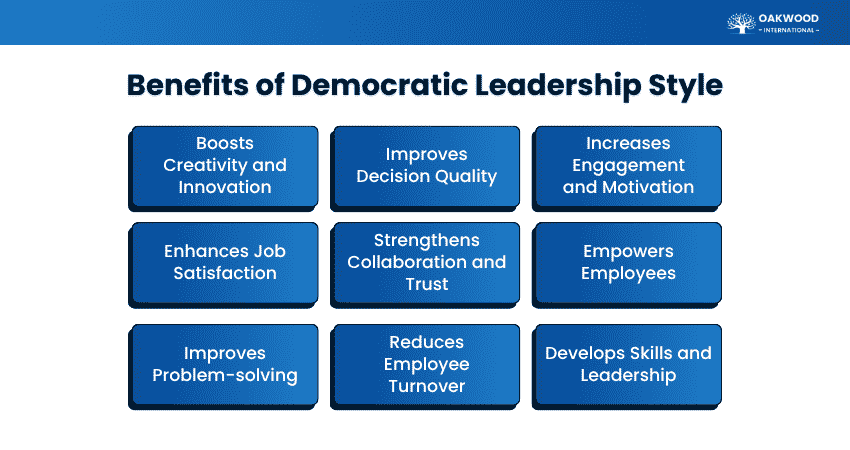
1) Boosts Creativity and Innovation
Democratic Leadership encourages employees to contribute ideas, collaborate on decisions, and take ownership of their work. By valuing diverse perspectives, it helps organisations improve innovation, teamwork, employee satisfaction, and overall business performance.
2) Improves Decision Quality
Democratic Leadership creates an environment where employees feel comfortable sharing ideas and suggestions. Open discussions encourage creative thinking, helping organisations develop innovative solutions and improve processes.
3) Increases Engagement and Motivation
When employees are involved in decision-making, they feel their opinions are valued. This strengthens engagement, motivates them to contribute, and encourages greater commitment to organisational goals.
4) Enhances Job Satisfaction
Democratic Leadership empowers employees to participate in organisational decisions and recognises their contributions. Feeling respected and trusted improves job satisfaction and creates a more positive workplace.
5) Strengthens Collaboration and Trust
This leadership style promotes teamwork by encouraging employees to work together, exchange ideas, and support one another. As collaboration increases, stronger workplace relationships and trust naturally develop.
6) Empowers Employees
Employees are encouraged to take ownership of their responsibilities and contribute to important decisions. This empowerment builds confidence, accountability, and a stronger sense of responsibility.
7) Improves Problem-solving
Involving employees in solving challenges brings together different perspectives and areas of expertise. This collaborative approach helps organisations identify practical solutions and make better decisions.
8) Reduces Employee Turnover
Employees who feel valued, involved, and recognised are more likely to remain with an organisation. Higher job satisfaction and stronger workplace relationships contribute to improved employee retention.
9) Develops Skills and Leadership
Democratic Leadership encourages employees to communicate, collaborate, and participate in decision-making. These opportunities help develop leadership, communication, problem-solving, and interpersonal skills for future career growth.
Challenges of the Democratic Leadership Style
Despite its advantages, Democratic Leadership has limitations that can affect efficiency and decision-making. Involving multiple opinions can slow processes and create challenges in some situations. Key pitfalls of this leadership style include the following:
1) Slower Decision-making
Democratic Leadership requires leaders to gather feedback and consider different viewpoints before making decisions. While this often improves outcomes, it can delay decision-making, especially in fast-paced or time-sensitive situations.
2) Indecisiveness and Ambiguity
When multiple opinions influence decisions, roles and responsibilities can become unclear if the leader does not provide clear direction. This uncertainty may slow execution and reduce team productivity.
3) Conflict and Tension
Open discussions encourage diverse viewpoints, but they can also lead to disagreements and interpersonal conflicts. Strong personalities may dominate conversations, making it difficult for quieter team members to contribute equally.
4) Less Effective with Inexperienced Teams
Democratic Leadership depends on meaningful employee contributions. Teams with limited experience or insufficient knowledge may struggle to provide valuable input, reducing the effectiveness of collaborative decision-making.
5) Leader Burnout
Encouraging participation, managing discussions, resolving disagreements, and balancing different viewpoints require significant time and effort. Over time, these responsibilities can place additional pressure on leaders and contribute to burnout.
6) Risk of Reduced Performance
A strong focus on consensus may make it difficult to address poor performance or hold employees accountable. Delayed decisions, unclear ownership, or unequal participation can affect team efficiency and overall performance.
Advance your management career with the
CMI Level 4 Certificate in Management and Leadership
– Join now!
How to Implement a Democratic Leadership Style?
Applying Democratic Leadership effectively requires strategic effort and strong interpersonal skills. Below are practical steps to implement this leadership style:
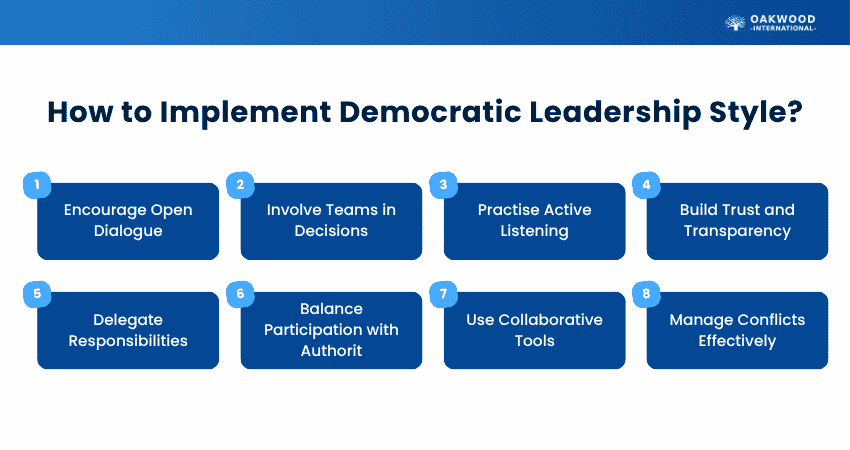
1) Encourage Open Dialogue
Create opportunities for employees to share ideas, ask questions, and provide feedback without fear of criticism. Regular discussions and open communication help build trust, improve collaboration, and encourage innovation.
2) Involve Teams in Decisions
Seek input from team members before making important decisions, particularly on matters that affect their work. Involving employees promotes ownership, increases commitment, and leads to more informed decisions.
3) Practise Active Listening
Listen carefully to different viewpoints and demonstrate that employee feedback is valued. Active listening enables leaders to understand concerns, evaluate ideas fairly, and strengthen team relationships.
4) Build Trust and Transparency
Share organisational goals, explain how decisions are made, and communicate openly throughout the process. Transparency builds trust and helps employees understand how their contributions influence outcomes.
5) Delegate Responsibilities
Assign responsibilities based on employees' strengths and encourage them to take ownership of tasks and decisions. Delegation builds confidence, develops leadership skills, and increases accountability across the team.
6) Balance Participation with Authority
While employee input is valuable, leaders should clearly define when collaboration is appropriate and when they must make the final decision. Maintaining this balance keeps decision-making efficient while preserving team involvement.
7) Use Collaborative Tools
Use digital platforms such as shared workspaces, surveys, and feedback tools to gather ideas, track decisions, and encourage participation. These tools make collaboration more organised and accessible for all team members.
8) Manage Conflicts Effectively
Encourage respectful discussions and address disagreements promptly to keep collaboration productive. By resolving conflicts fairly and focusing on shared goals, leaders can maintain trust and strengthen team relationships.
Examples of Democratic Leadership
Democratic Leadership is not limited to corporate organisations; it is also seen in sectors that value collaboration and shared decision-making. This leadership style is particularly effective in environments where diverse perspectives contribute to better outcomes. Below are some notable examples:
1) Corporate Organisations
Companies like Google and Microsoft practise Democratic Leadership by encouraging employee input and open discussions. This approach drives innovation and supports collaborative decision-making.
2) Leadership Styles of CEOs
Leaders such as Satya Nadella and Tim Cook are often associated with inclusive leadership practices that value diverse viewpoints. By encouraging dialogue and participation, their leadership styles enable teams to influence strategy and organisational direction.
3) Workplace Practices
Brainstorming sessions, worker cooperatives, and collaborative healthcare teams demonstrate Democratic Leadership in action. These practices ensure multiple voices shape decisions, improving engagement and outcomes.
4) Educational Institutions
Schools and universities apply Democratic Leadership by involving teachers and students in decision-making. Committees and councils help stakeholders influence policies and institutional improvements.
5) Project and Agile Teams
Agile teams use Democratic Leadership during planning and retrospectives, where every group member contributes ideas and feedback. This collaborative approach enhances problem-solving, adaptability, and project success.
Conclusion
When teams feel heard, empowered, and valued, organisations thrive. Democratic Leadership turns ideas into action, collaboration into strength, and participation into progress. By encouraging shared responsibility and open dialogue, it builds motivated teams and innovative cultures that drive lasting success and meaningful organisational growth.
Develop practical leadership and management expertise with CMI Level 4 Training - Sign up today!
Frequently Ask Questions
When is the Best Time to Use Democratic Leadership?
Democratic Leadership works best when time is available, teams consist of skilled professionals, and innovation and collaboration are priorities. It encourages diverse perspectives, supports complex problem-solving, and builds strong employee commitment through shared decision-making and collective ownership of outcomes.
Is it Good to Be a Democratic Leader?
Yes, it is. Democratic Leadership helps build a collaborative and innovative workplace by encouraging team participation and shared decision-making. However, because it depends on group input and consensus, it can be time-consuming and is less effective during urgent situations or when leading inexperienced teams.
When is a Democratic Leadership the Least Effective?
Democratic Leadership is least effective during emergencies, with inexperienced teams or for routine tasks that require quick decisions. Its focus on collaboration and consensus can slow decision-making, making it unsuitable when fast action, clear direction, and strong leadership are essential.
Related Blogs
Didn’t Find What You’re Looking For?

Our commitment to excellence ensures an exceptional learning experience tailored to your professional development needs.


© Copyright 2026 - Oakwood International ™ - All rights reserved.


SUPER SALE
 Get Amazing Discounts
And Deals
Get Amazing Discounts
And Deals