

 Back
Back


 Back to Catagories


Table of Contents


 + 44 7452
122728
+ 44 7452
122728
 27-Jul-2026
Maria Thompson
People drive every successful organisation, yet many businesses still struggle to measure the true value their workforce creates. Companies invest heavily in hiring, training, and development, but without clear metrics, it is hard to know what truly delivers results. This is where Human Capital ROI bridges this gap by turning people investments into meaningful business insight.
This blog explains Human Capital ROI and why it matters for modern organisations. It also covers how the formula works and compares it with other HR metrics to support confident, data-driven workforce decisions.
Table of contents
1) What is Human Capital ROI?
2) Importance of Human Capital ROI
3) The Human Capital ROI Formula
4) Why Should Companies Calculate Human Capital ROI?
5) Challenges in Measuring Human Capital ROI
6) Human Capital ROI vs Other HR Metrics
7) Conclusion
What is Human Capital ROI?
Human Capital Return on Investment (HCROI) is a strategic metric that measures the financial value gained from investing in employees. It compares workforce costs, such as pay, benefits, and training, with the value and profit they generate to show whether people investments deliver real returns.
By turning people's data into financial insight, Human Capital ROI shifts HR from being seen as a cost centre to a value driver. It allows organisations to justify HR spending, improve productivity, and align workforce strategies with overall business goals using clear, measurable evidence.

Importance of Human Capital ROI
Human Capital ROI shows how employee investments, including wellbeing and workplace health initiatives, create real financial value for the business. It replaces intuition with data, revealing how people strategies drive profitability and growth while aligning HR with business goals.
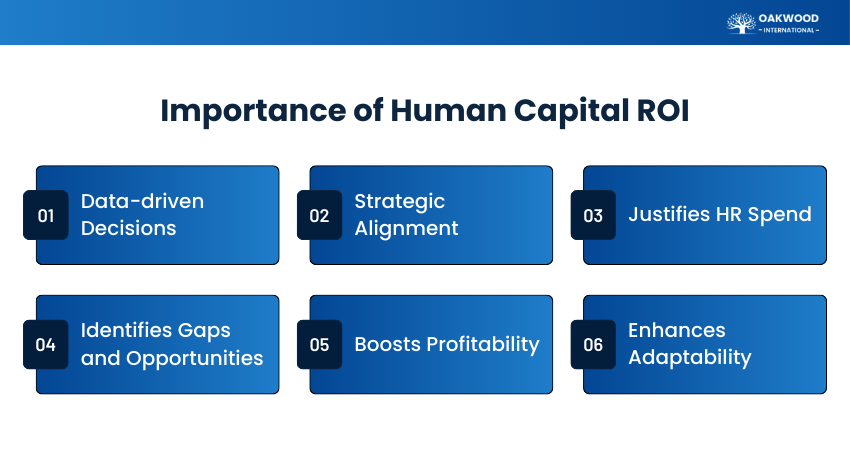
Key Importance of Human Capital ROI:
1) Data-driven Decisions: Shows the financial impact of HR initiatives like training, hiring, and retention.
2) Strategic Alignment: Connects workforce strategies with overall business objectives.
3) Justifies HR Spend: Proves that investment in people delivers measurable returns.
4) Identifies Gaps and Opportunities: Highlights of underperformance and areas with high return potential.
5) Boosts Profitability: Links effective people management directly to stronger financial results.
6) Enhances Adaptability:
Helps organisations respond quickly to market and workforce changes.
The Human Capital ROI Formula
The Human Capital ROI formula explains how effectively an organisation’s investment in employees turns into financial value. It compares the costs of employing people, such as salaries and benefits, with the profit generated from their work, showing whether workforce spending is delivering meaningful returns.
Human Capital ROI Formula:

Explanation:
1) Revenue: The total income generated by the organisation.
2) Operating Expenses: All business costs except employee compensation.
3) Compensation Costs:
Salaries, wages, benefits, and other people-related expenses.
Why Should Companies Calculate Human Capital ROI?
Calculating Human Capital ROI turns workforce efforts into clear financial insight. It shows whether investments in people improve revenue, productivity, and profitability, enabling smarter, data-driven decisions. Here’s why measuring it matters:
1) Assess the Effectiveness of Human Capital Initiatives
Human Capital ROI enables organisations to evaluate whether initiatives such as training, engagement programmes, or talent development are delivering meaningful returns. Instead of relying on assumptions, companies can see if these investments positively impact revenue and performance. This ensures resources are spent where they create real value.
2) Demonstrate the Impact of HC Strategies to Leadership
Human Capital ROI provides clear, financial evidence of how people strategies influence business results. It helps HR teams communicate outcomes in a language senior leaders understand. This makes it easier to gain leadership buy-in and support for future workforce investments.
3) Identify and Address Human Capital Gaps
By analysing Human Capital ROI, organisations can identify both strengths and gaps within their workforce. It highlights areas where skills, productivity, or capacity may be lacking. With these insights, businesses can refine hiring, training, or workforce planning decisions to improve overall performance.
4) Improve Human Capital Processes
Human Capital ROI insights reveal which HR processes are effective and which need improvement. If certain initiatives fail to deliver returns over time, organisations can refine or replace them. This continuous improvement approach helps optimise workforce strategies and long-term business outcomes.
Gain essential HR skills and take your first step toward a successful HR career with the
HR Course
– Register now!
Challenges in Measuring Human Capital ROI
Measuring Human Capital ROI is challenging because many workforce benefits are long-term or intangible. Results may take time to appear, and outcomes are influenced by factors beyond people's investments and data quality.
Key Challenges Include:
1) Intangible Benefits: Improvements in morale, culture, and reputation are hard to quantify
2) Time Lag: The impact of training or development may take months or years to show
3) Attribution Issues: Financial results cannot always be linked to a single HR initiative
4) Data Accuracy: Incomplete or inconsistent data can affect reliability
5) External Factors:
Market and economic conditions can influence ROI results
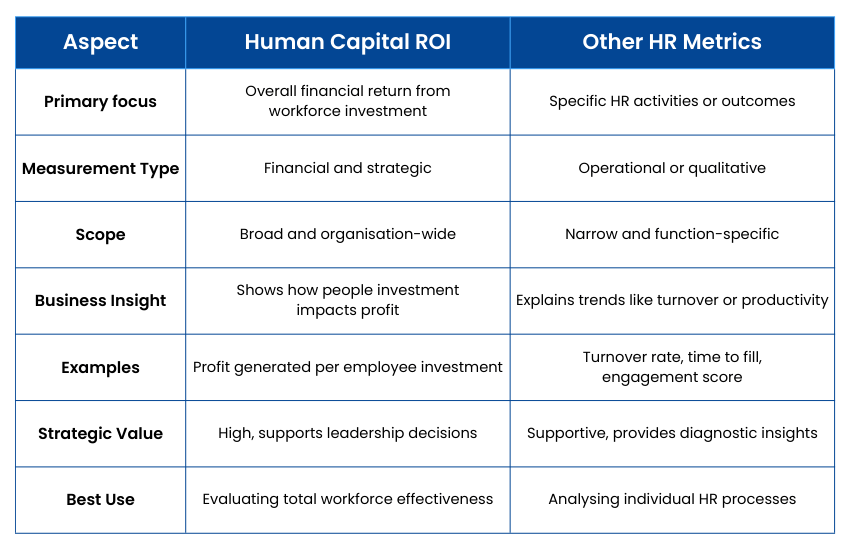
Human Capital ROI vs Other HR Metrics
Human Capital ROI shows how workforce investments impact business performance, while other HR metrics focus on specific areas. Together, they link people's efforts to profitability and give a balanced view of workforce effectiveness. Here’s how they compare:
Conclusion
Human Capital ROI helps organisations see people as drivers of business value, not just costs. By linking workforce investment, including employee health, to financial outcomes, it supports smarter decisions, stronger HR alignment, and continuous improvement. Combined with other HR metrics, it drives sustainable growth and competitive advantage.
Build confident HR leadership skills and drive organisational success with HR Leadership Courses – Join now!
Frequently Ask Questions
What is Capital ROI?
Capital ROI, or Return on Investment, measures how profitable an investment is by comparing the gain or loss against its cost. Expressed as a percentage, it helps businesses measure efficiency, compare opportunities, and make informed decisions, though it does not account for time or risk factors.
How to Measure HR ROI?
HR ROI is measured by comparing the financial gains of an HR initiative with its cost using the formula (Gain from Investment − Cost of Investment) ÷ Cost of Investment × 100%. It considers outcomes like productivity gains, reduced turnover, and efficiency improvements to assess value.
Is 20% ROI Realistic?
Yes, a 20% ROI is realistic but considered a strong return, often linked to higher-risk or high-growth investments. Achieving it depends on market conditions, strategy, time horizon, and willingness to accept volatility.
Related Blogs
Didn’t Find What You’re Looking For?

Our commitment to excellence ensures an exceptional learning experience tailored to your professional development needs.


© Copyright 2026 - Oakwood International ™ - All rights reserved.


SUPER SALE
 Get Amazing Discounts
And Deals
Get Amazing Discounts
And Deals