

 Back
Back


 Back to Catagories


Table of Contents


 + 44 7452
122728
+ 44 7452
122728
 22-Jul-2026
Maria Thompson
Have you ever wondered why some organisations grow stronger with every challenge while others struggle to keep up? The difference often lies in how well they understand their people, their processes, and the changes around them. When these elements align, organisations become more adaptable and forward-thinking. Organisational Development supports this by helping businesses stay innovative and flexible in a constantly changing world.
In this blog, you will explore what Organisational Development is, its goals, key characteristics, and the processes involved. You will also discover the benefits that enable organisations to become more agile and future-ready. Let’s dive in.
What is Organisational Development?
Organisational Development (OD) is a process that helps businesses enhance their effectiveness and achieve sustainable growth. It focuses on strengthening teamwork, communication, and leadership while implementing planned changes to organisational culture, structure, or processes. These efforts help employees work more efficiently and contribute to achieving business objectives.
Companies use Organisational Development to solve problems and make the business stronger. For example, if employees are unhappy or productivity is low, it helps find solutions. A company might introduce better training and a positive work environment. When employees feel supported and motivated, they perform better, which benefits the entire organisation.

What are the Goals of Organisational Development (OD)?
Organisational Development (OD) aims to improve an organisation’s overall effectiveness by enhancing its people, processes, culture, and structure. Its goals focus on creating a productive and adaptable workplace where employees can perform at their best while supporting long-term business success.
Here are the goals of Organisational Development:
1) Teamwork and Communication: Helps employees collaborate smoothly, avoid misunderstandings, and work towards shared goals.
2) Efficient Processes: Makes daily tasks faster and more effective by removing delays and improving workflows.
3) Positive Workplace: Builds an environment where employees feel supported, valued, and encouraged to give their best.
4) Innovation and Creativity: Encourages new ideas, experimentation, and smarter ways to solve challenges.
5) Confident Leadership: Helps managers lead teams with clarity, fairness, and stronger decision-making.
6) Employee Engagement: Increases involvement and commitment by helping people feel connected to the organisation’s purpose.
7) Change Readiness:
Prepares the organisation to adapt quickly and confidently to new situations or market shifts.
Key Characteristics of Organisational Development
Organisational Development is characterised by a planned and systematic approach to enhancing overall business performance. Let's check its characteristics:
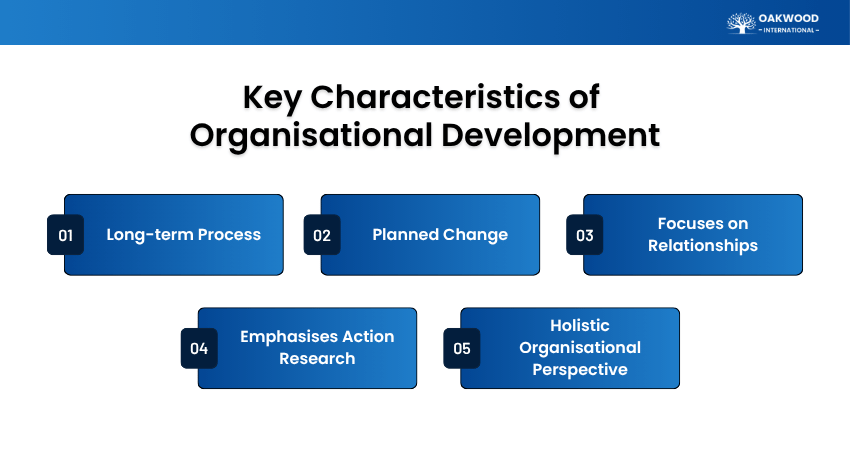
Long-term Process
Organisational Development is a continuous, long-term process focused on improving organisational effectiveness and achieving sustainable success. Rather than implementing change all at once, organisations introduce improvements gradually, regularly monitor progress, and make adjustments as needed to ensure ongoing growth and positive outcomes.
Planned Change
This characteristic focuses on structured and well-planned change rather than random, reactive or uncoordinated actions. Organisations analyse existing challenges, involve employees throughout the process, and implement clear strategies to create a more efficient, productive, and sustainable workplace.
Focuses on Relationships
Strong employee relations encourage teamwork, open communication, and trust between employees and management. By creating a positive and supportive work environment where individuals feel valued and respected, organisations can improve collaboration, enhance workplace morale, and help employees work more efficiently towards shared goals.
Emphasises Action Research
Organisations analyse workplace challenges, collect relevant data, and identify opportunities for improvement. With this characteristic, employees and managers collaborate to test potential solutions, while decisions are guided by real-world experiences and insights to ensure practical and effective change.
Holistic Organisational Perspective
This approach takes a holistic view of the organisation by considering how all departments, processes, leadership practices, and workplace culture work together. It helps ensure alignment across the business, enabling organisations to adapt to change more effectively and maintain a competitive advantage.
Gain foundational HR knowledge and boost your career prospects with the
CIPD Level 3 Certificate in People Practice Course
– Join now!
What is the Process of Organisational Development?
Organisational Development follows a step-by-step process to help businesses grow and improve. Here are the key stages:
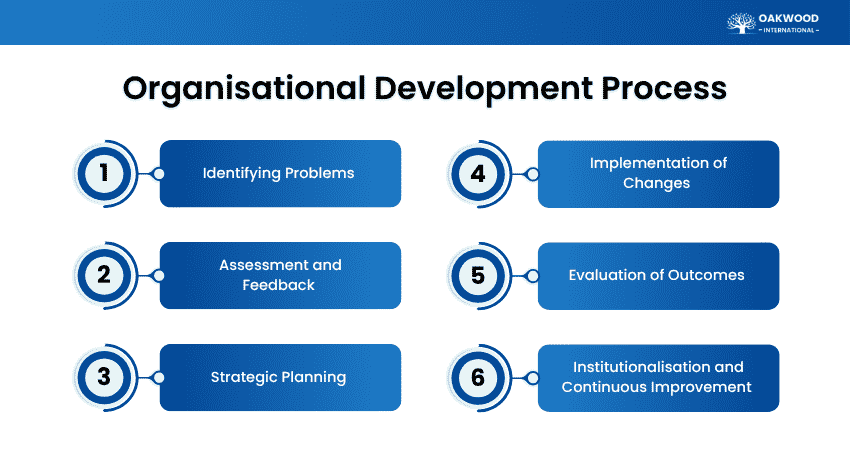
1) Identifying Problems
The first step is to find out what needs improvement. Businesses look at areas like teamwork, leadership, or work efficiency. Understanding the problem helps in planning the right solutions.
a) Conduct surveys or meetings to understand employee concerns
b) Analyse work processes to find areas that need change
c) Identify challenges that affect productivity and growth
2) Assessment and Feedback
Businesses collect information from employees and managers to understand the situation better. Feedback helps in identifying what is working and what needs improvement. This step ensures that changes are based on real workplace experiences.
a) Gather feedback through interviews, surveys, or performance reports
b) Compare employee experiences with business goals
c) Use the data to create a clear picture of the organisation’s strengths and weaknesses
3) Strategic Planning
After gathering information, businesses create a clear plan for change. This includes setting goals, defining actions, and deciding how to measure success. A good strategy ensures smooth and effective improvements.
a) Set clear objectives to solve identified problems
b) Plan step-by-step actions for employees and managers
c) Assign roles to ensure accountability for changes
4) Implementation of Changes
After planning is complete, organisations begin implementing the proposed changes. This may involve introducing new processes, updating policies, providing training, or restructuring teams. Effective communication and employee involvement are essential to ensure a smooth transition and successful adoption of change.
a) Introduce new processes, systems, or workplace practices
b) Provide training and support to employees during the transition
c) Monitor adoption and address any resistance to change
5) Evaluation of Outcomes
Once changes are in place, businesses check if they are effective. This step helps in understanding what worked well and what needs more improvement. Success is measured through feedback and performance analysis.
a) Review employee performance and productivity levels
b) Compare the results with initial goals and expectations
c) Identify any further improvements needed
6) Institutionalisation and Continuous Improvement
The final step ensures that changes become a permanent part of the organisation. Businesses focus on ongoing improvements to sustain positive change and support long-term growth. Employees are encouraged to share ideas for further development.
a) Establish new policies as part of the Organisational Culture .
b) Regularly update strategies to meet business needs
c) Encourage innovation and learning for long-term success
Build advanced People Management skills and boost your career progression with the
CIPD Level 5 Associate Diploma in People Management Course
– Join now!
Benefits of Organisational Development
Here are the benefits of Organisational Development:
1) Employee Growth
a) Provides training to improve skills and knowledge
b) Helps employees take on new responsibilities and grow in their careers
c) Encourages a learning culture for personal and professional development
2) Better Communication
a) Improves teamwork by encouraging open discussions
b) Reduces misunderstandings and makes work processes smoother
c) Builds trust between employees and management
3) Continuous Development
a) Encourages businesses to keep improving and adapting
b) Allows companies to stay competitive in a changing market
c) Supports innovation by promoting new ideas and strategies
4) Talent Acquisition
a) Attracts skilled professionals looking for career growth
b) Creates a positive work environment that people want to join
c) Increases employee retention by offering development opportunities
5) More Revenue
a) Improves efficiency, leading to better productivity and profits
b) Enhances customer satisfaction, boosting sales and business growth
c) Reduces costs by making work processes more effective
6) Promote Loyalty and Commitment
a) Helps employees feel valued and increases long-term retention
b) Strengthens company culture, leading to higher engagement
c) Encourages employees to contribute to business success
Strengthen your decision-making and strategic People Management skills with the
CIPD Level 7 Advanced Diploma in Strategic People Management Course
– Join now!
Challenges in Organisational Development
Here are some of the common challenges organisations may face when implementing Organisational Development initiatives:
1) Employee Resistance: People often feel uncomfortable with change and prefer sticking to familiar ways. If not managed well, resistance can slow down progress and reduce the success of new initiatives.
2) Lack of Clear Goals: Without clear goals, employees may not understand what changes are being made or why they matter. This can create confusion and a lack of motivation.
3) Limited Resources: Some businesses struggle with not having enough time, money, or staff to support organisational changes. This can delay improvements and lower their effectiveness.
4) Poor Communication: Lack of clear communication can cause misunderstandings and frustration among employees. Without proper updates, workers may feel left out or unsure about what is happening.
5) Management Support Issues: For changes to succeed, leaders must actively support and guide employees. Without strong leadership, Organisational Development efforts may fail.
6) Short-term Focus:
Some businesses focus only on immediate results rather than long-term growth. This can result in rushed decisions that do not create lasting improvements.
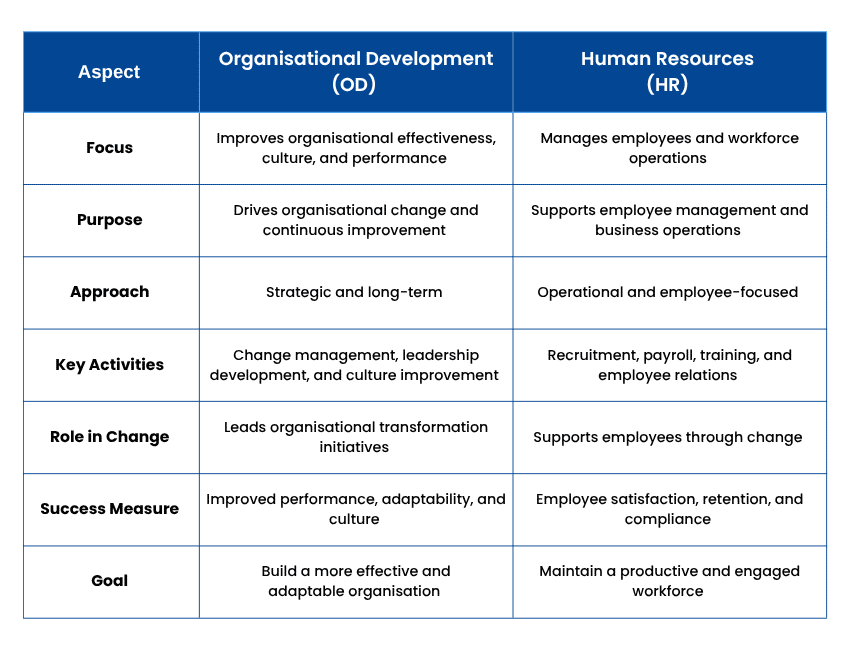
Organisational Development vs Human Resources: Key Differences
Organisational Development strengthens a company’s structure, culture, and processes to support long-term growth and effective change. It uses a strategic approach that analyses challenges, encourages innovation, builds leadership, and involves employees in shaping improvements.
In contrast, Human Resources (HR) manages everyday employee needs such as recruitment, payroll, policies, and compliance. It maintains smooth operations by handling employee relations, resolving conflicts, managing performance, and serving as a link between staff and management.
Examples of Organisational Development
Some of the examples of Organisational Development are:
1) Employee Training Sessions
a) A company offers regular training to help employees learn new skills.
b) Managers provide leadership workshops to improve decision-making.
c) Businesses invest in online courses to keep employees updated on industry trends.
2) Improving Workplace Culture
a) A company introduces team-building activities to strengthen teamwork
b) Businesses encourage open communication between employees and managers
c) Companies create policies that promote diversity and inclusion in the workplace
3) Adopting New Technology
a) A business upgrades its software to make it work faster and more efficiently
b) Companies introduce automation tools to reduce manual tasks
c) Organisations provide training to help employees adapt to new technology
Conclusion
Organisational Development plays a vital role in helping companies grow, adapt and stay competitive. Improving culture, processes and people creates a stronger and more agile workplace. When organisations invest in continuous improvement and employee development, they build long-term success and become better prepared for future challenges.
Advance your HR journey today with globally recognised CIPD Qualification Training from expert-led trainers.
Frequently Ask Questions
What Does OD Mean in HR?
In HR, Organisational Development (OD) refers to planned efforts to improve how a company works. It focuses on strengthening culture, processes, leadership and employee performance to support long-term growth and a more effective workplace.
What is the Difference Between OD and L&D?
Organisational Development (OD) improves overall organisational effectiveness by strengthening culture, structure, processes, and leadership to support long-term growth and planned change. Learning and Development (L&D) focuses on building employee skills through training and development initiatives to enhance individual performance in their roles.
What Skills are Needed for OD?
Successful Organisational Development (OD) requires a blend of behavioural science and business expertise. Key competencies include change management to support transitions, systems thinking to understand the wider organisation, data analysis for informed decisions, and consultation and facilitation skills to build align strategies.
Related Blogs
Didn’t Find What You’re Looking For?

Our commitment to excellence ensures an exceptional learning experience tailored to your professional development needs.


© Copyright 2026 - Oakwood International ™ - All rights reserved.


SUPER SALE
 Get Amazing Discounts
And Deals
Get Amazing Discounts
And Deals